

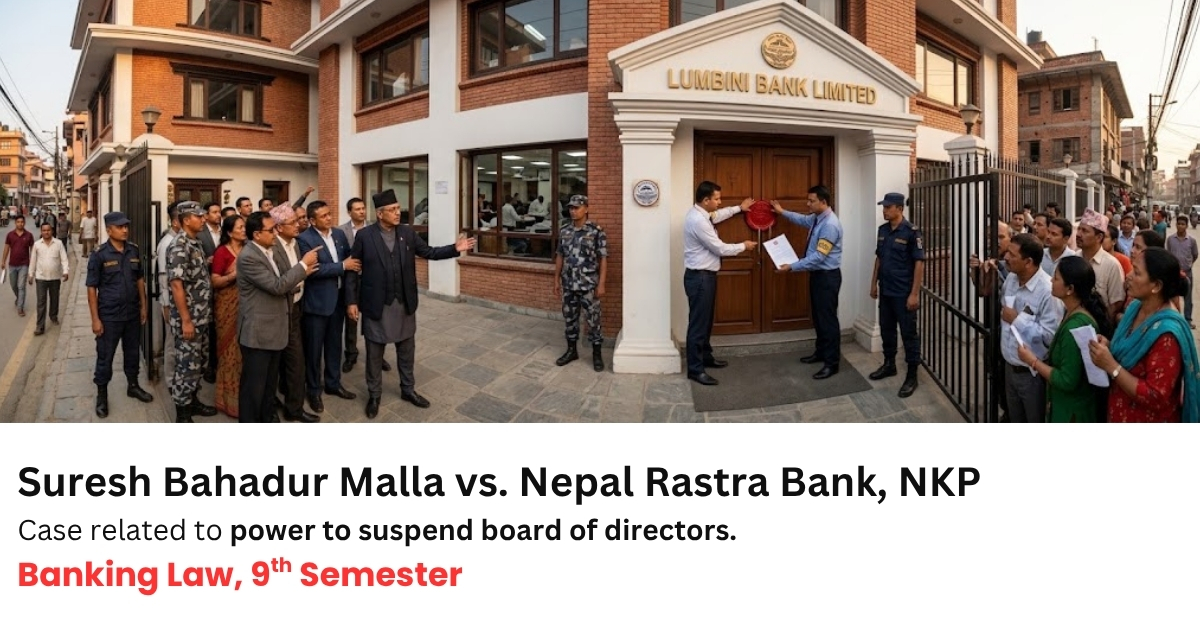
Banking Law Case: Suresh Bahadur Malla vs. Nepal Rastra Bank,Central Office, NKP (2060), No. 1/2, P.13.
Case: Writ of Certiorari and Other Appropriate Orders
Petitioner/Applicant: Suresh Bahadur Malla
Defendant/Respondent: Nepal Rastra Bank and others
Decision Number: 7162
This case is about who has the power to suspend a bank’s board of directors and take control of the bank. Whether it is the Board of Nepal Rastra Bank itself, or whether the Governor of Nepal Rastra Bank can act alone.
Facts of the Case:
Lumbini Bank Limited was a licensed commercial bank, and Suresh Bahadur Malla was its Chairman. The bank expanded rapidly, opened several branches, and attracted large deposits.
Nepal Rastra Bank later restricted the bank’s Kathmandu branch, which led to significant withdrawals by depositors. While the bank was trying to have the restriction removed, Nepal Rastra Bank asked the bank’s Board of Directors to submit an explanation. The directors submitted their explanation.
Nepal Rastra Bank then suspended the bank’s Board of Directors and took control of the bank under the Nepal Rastra Bank Act, 2058.
Malla challenged this action, arguing that proper legal procedure had not been followed and that the authority to suspend the Board belonged to the Board of Nepal Rastra Bank, not the Governor or its officials. He therefore filed a writ petition challenging the takeover.
Legal Issues:
- Whether the case had become pointless (moot), since the original 1-year Management Committee period had already ended.
- Whether the Governor of Nepal Rastra Bank has legal power to suspend a commercial bank’s board and take control of the bank.
- Whether the actual action taken to control Lumbini Bank followed the law.
- Whether the order requested by the petitioner should be issued.
Different Court’s Decisions:
Supreme Court’s Joint Bench Decision:
The two-judge bench disagreed on whether the Governor had authority to take over the bank.
- Justice Gopal Prasad Khatri held that only the Nepal Rastra Bank Board of Directors had the power to take over the bank under Section 86(1).
- Justice Chandra Prasad Parajuli held that the Governor had such authority under the existing legal framework.
Since the judges could not agree, the case was referred to a three-judge bench for a final decision.
Full Bench Decision:
The Full Bench dismissed the writ petition and upheld Nepal Rastra Bank’s decision to suspend Lumbini Bank’s Board and take control of the bank.
The Court held that the Governor of Nepal Rastra Bank had legal authority to suspend a commercial bank’s Board and take control of the bank. This power did not have to be exercised by the Nepal Rastra Bank Board of Directors.
The Court also held that old rules continue to apply when new rules have not yet been made under a new law, as long as they do not conflict with the new law.
The Court found that Nepal Rastra Bank had properly inspected the bank and given it an opportunity to explain its position. The inspections showed serious problems in the bank’s management and lending practices, and the bank had failed to make sufficient improvements. The Court therefore found the takeover lawful and justified.
Principle Established:
- The Governor of Nepal Rastra Bank can suspend a commercial bank’s Board and take control of the bank under the Nepal Rastra Bank Act, 2058.
- Old rules remain applicable until new rules are made, as long as they do not conflict with the new law.
- Nepal Rastra Bank can take control of a bank when serious problems are found and the bank fails to improve after being given an opportunity to respond.
- A case remains relevant if a later decision continues the same disputed action.