

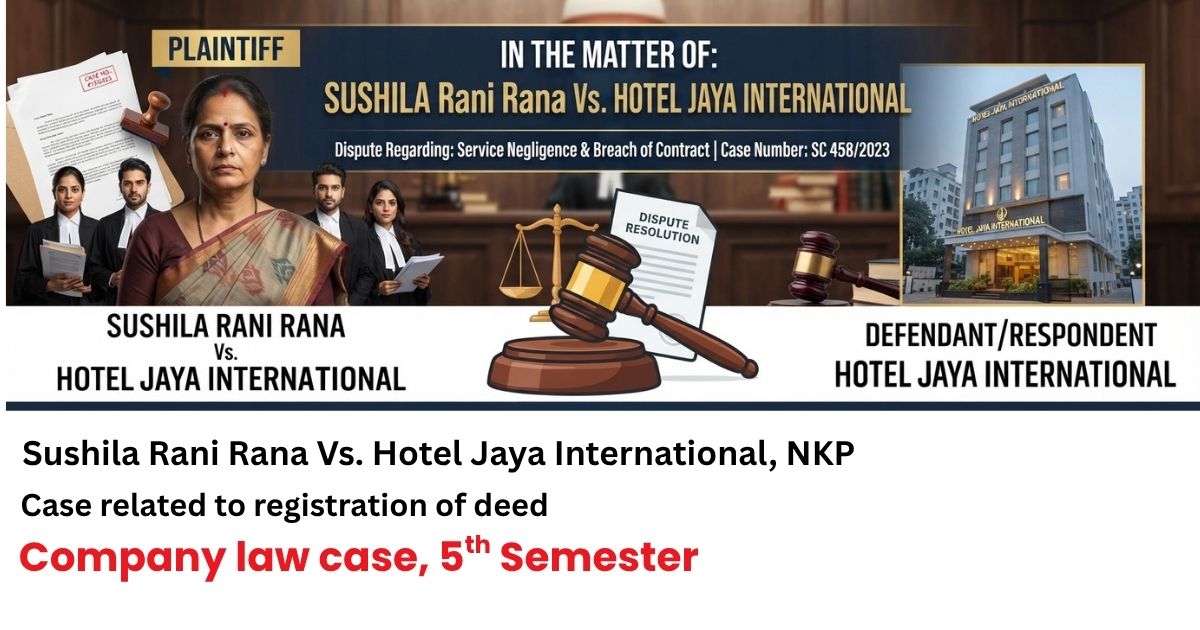
Company Law Case: Sushila Rani Rana Vs. Hotel Jaya International, NKP, 2040, No. 3, P. 259.
Case: Deed Registration
Plaintiff: Anand Bahadur Shrestha on behalf of Hotel Jaya International Pvt. Ltd.
Defendant: Sushila Rani Rana
em>Decision No: 1938
This case is related to registration of deed.
Facts of the case:
On Marg 29, 2034 BS, defendant executed a deed to transfer land and a house to Hotel Jaya International Pvt. Ltd. in exchange for a loan of Rs. 1,50,000/- When the deed was not officially registered Anand Bahadur Shrestha filed a lawsuit on behalf of the company in the Lalitpur District Court. Both District Court and Mid-Regional Court ruled in favor of plaintiff, ordering the registration of the deed. Dissatisfied with these judgments, defendant obtained leave to appeal to the Supreme Court, leading to this Division Bench hearing.
Plaintiff’s Claim:
Plaintiff, Hotel Jaya International Pvt. Ltd., claimed that on 2034/8/29 BS, defendant borrowed Rs. 1,50,000/- for household and construction purposes. In return, defendant executed a deed promising to register and transfer land and a house registered under her name in Lalitpur. When defendant dilly-dallied in executing and registering the deed despite repeated requests, plaintiff filed a lawsuit within the statutory limitation period under Section 82 of the General Code (A.B. 82) seeking an order to compel the execution of the deed.
Defendant’s Arguments:
Sushila Rani Rana, denied receiving the stated amount or executing the document for that purpose. She argued that after she agreed to give the property to the company, it was orally agreed to keep a low valuation of Rs. 1,50,000/- for the land and house, and that upon passing the deed, the company would issue her company shares equivalent to that value. When she asked for both the deed registration and the share certificates simultaneously, plaintiff delayed the share certificates and filed a lawsuit with the malicious intent of taking the property without any consideration. She requested a dismissal of the false claim.
Legal Issues:
- Does a person have the legal standing to file a lawsuit on behalf of a private limited company incorporated under the Companies Act without explicit authorization or representation granted by the company’s Board of Directors?
Decisions of the Courts:
Lalitpur District Court: Court ordered that the document showed that defendant had indeed received the amount and the lawsuit was filed within the statutory limitation period therefore it ruled in favor of plaintiff ordering the deed to be registered.
Mid-Regional Court Decision: It held that defendant failed to submit proof that she did not receive the money mentioned in the deed and the lawsuit was validly registered by plaintiff Anand Bahadur Shrestha under a power of attorney therefore it upheld the District Court’s judgment.
Supreme Court Division Bench: Dismissed plaintiff’s lawsuit under Section 82 of the General Code (A.B. 82) and overturned previous lower court decisions. Section 69 of the Companies Act, 2021 assigns the management and authority of the company to the Board of Directors, and Sub-section (4) allows them to delegate authority to a director or employee. Plaintiff failed to mention in the plaint or prove through documents how he obtained authorization from the Board of Directors to file the lawsuit. Merely stating “on behalf of Hotel Jaya International Pvt. Ltd.” in the plaint does not fulfill the statutory requirement. Therefore, a lawsuit filed by a person lacking legal authority is liable to be dismissed.
Established Principles:
- Mandatory Corporate Representation: A lawsuit or legal action on behalf of a private limited company must be backed by explicit authorization or valid delegation of power from the Board of Directors in accordance with the Companies Act and company rules. Merely mentioning the company’s name does not establish individual standing.
- Dismissal of Suit Due to Lack of Standing: Lawsuits filed by unauthorized individuals or lacking proper legal standing are subject to dismissal under Section 82 of the General Code.