
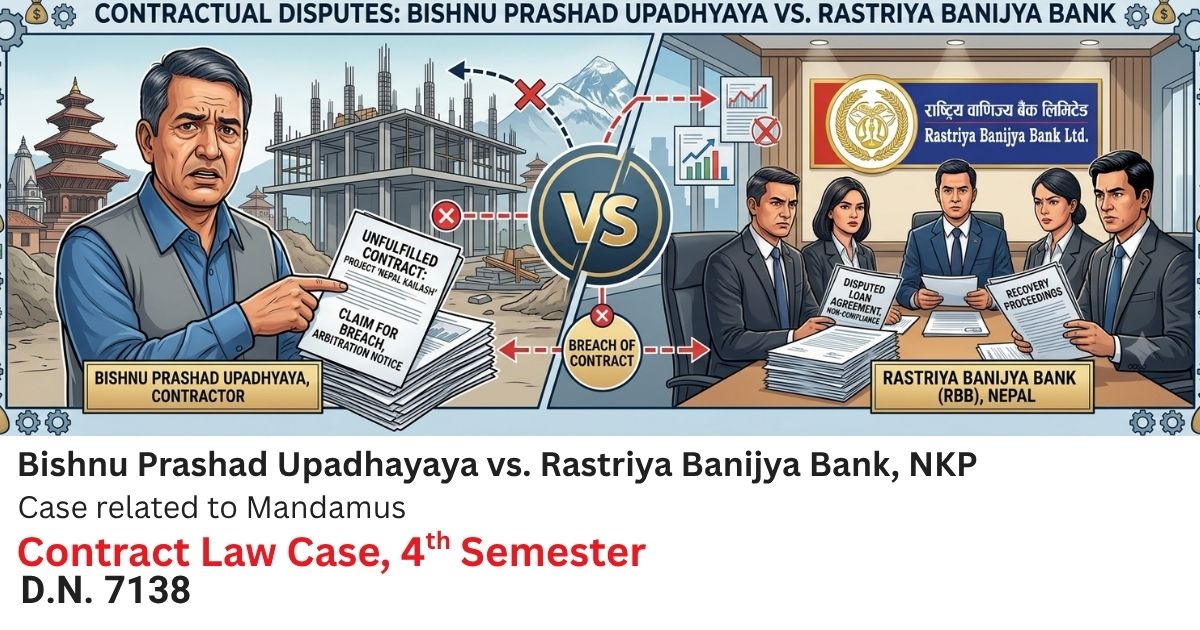
Contract Law Case: Bishnu Prashad Upadhayaya vs. Rastriya Banijya Bank, NKP, 2059, No. 9/10, P. 659, D.No. 7138
Case: Writ of Mandamus
Plaintiff: Bishnu Prasad Upadhyaya
Defendants: Rastriya Banijya Bank, Branch Office, Surkhet
Decision Number: 7138
This case is related to Mandamus, Release of Mortgaged Property, Doctrine of Contractual Guarantee.
Facts of the Case:
Petitioner had mortgaged his house and land to Rastriya Banijya Bank as security for loans taken for his construction business. After fully repaying those loans, he repeatedly requested the bank to release the mortgaged property but bank refused it because another loan of Rs. 5,00,000/- had been taken by Sharad Traders & Suppliers, a firm registered in the name of the petitioner’s wife, Sharad Kumari Upadhyaya. The security given for that loan had already been auctioned, but it was insufficient to recover the entire outstanding amount. Therefore, bank continued to keep petitioner’s property under attachment because he had personally managed the firm’s loan transaction and signed the required documents also agreed that if the mortgaged property was insufficient, the remaining debt could also be recovered from his other movable and immovable properties. Petitioner then filed a writ petition seeking an order directing the bank to release his property.
Plaintiff’s Claim:
petitioner claimed that he had completely repaid the loans taken in his own name therefore, bank had no legal authority to continue keeping his property under mortgage. His property had not been mortgaged as security for his wife’s business loan. The bank’s refusal to release the property violated his constitutional right to property. He requested the Court to issue a writ of Mandamus directing the bank to release the mortgaged land and house.
Defendants’ Arguments:
The bank argued that petitioner’s wife had taken a loan through Sharad Traders & Suppliers, and the loan remained unpaid. Petitioner himself had handled the loan transaction and signed the promissory note, and acted on behalf of the firm also he had expressly agreed that if the mortgaged property was insufficient to recover the loan, the bank could recover the remaining amount from his other properties. Therefore, the bank was legally entitled to continue attaching his property until the outstanding loan was fully recovered.
Legal Issues:
- Whether a bank can recover an unpaid loan from the guarantor’s other properties when the guarantor has agreed in writing that?
- Whether a bank can recover unpaid loan if the mortgaged property is insufficient, recovery may be made from his remaining movable and immovable properties?
Decisions of Courts:
Supreme Court (Joint Bench):
Justice Bhairav Prasad Lamsal held that the bank’s action was lawful and the writ petition should be dismissed.
Justice Kedar Prasad Giri held that the petitioner’s property should be released because it had not been directly mortgaged for the firm’s loan, and a writ of mandamus should be issued. Due to the conflicting opinions, the matter was referred to the Full Bench.
Supreme Court (Full Bench):
The Full Bench agreed with Justice Bhairav Prasad Lamsal and held that petitioner had personally guaranteed the loan and had agreed that his other properties could also be used to recover any unpaid balance. Since the bank acted according to the written agreement and the law, there was no violation of the petitioner’s constitutional right to property therefore, the writ petition was dismissed.
Established Principles:
- Where a guarantor expressly agrees in writing that the bank may recover any unpaid balance from his other movable and immovable properties, the bank is legally entitled to do so.
- A person who personally conducts a firm’s loan transaction, signs the necessary documents, and guarantees repayment cannot later deny liability for that loan merely because the firm is registered in another person’s name.
- A writ remedy is not available where the bank has acted according to the loan agreement and the law.
- A person seeking extraordinary constitutional relief must approach the Court with clean hands and cannot avoid obligations created by his own written undertaking.