
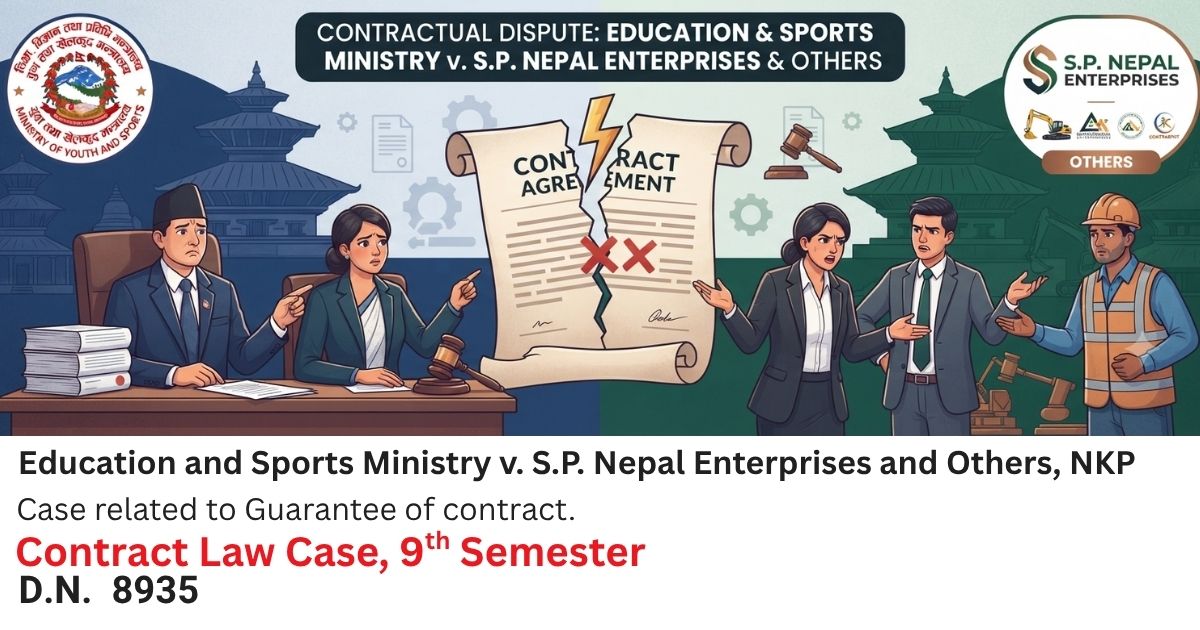
Contract Law Case: Education and Sports Ministry v. S.P. Nepal Enterprises and Others, NKP, 2069, No. 12, P. 1854, D.No. 8935
Case: Guarantee of contract.
Plaintiff: S.P. Nepal Enterprises, Gongabu, Kathmandu
Defendant: Government of Nepal, Ministry of Education and Sports, National Sports Council (Rastriya Khelkud Parishad)
Decision Number: 8935
This case is related to guarantor of loan.
Facts of the Case:
The Government invited tenders to sell tickets for the 8th South Asian Games. S.P. Nepal Enterprises submitted the successful bid and deposited a bank guarantee. Later, the Government informed the company that it could not provide all the tickets and seats originally promised. Therefore, both parties signed a revised contract reducing the number of tickets to be supplied. plaintiff sold the tickets received and argued that after deducting the value of the tickets that were never supplied and the tickets taken by the Police and the All Nepal Football Association, it had already paid all the money required under the contract and plaintiff further claimed that it had even overpaid a small amount and requested a refund along with the release of its bank guarantee. Defendants disagreed, claiming that plaintiff had failed to pay a substantial balance under the contract because it had received more tickets than it admitted and had not returned the unsold tickets. Consequently, they refused to release the bank guarantee.
Plaintiff’s Claim:
plaintiff claimed that government failed to provide all the tickets promised in the original tender under clause 2 of the contract, the payment should be reduced according to the reduced number of seats supplied, tickets used by the Nepal Police and the All Nepal Football Association should not be charged to plaintiff, after adjusting all payments plaintiff had already paid the required amount and had even overpaid. Therefore, the bank guarantee and other security should be released, and the excess payment should be refunded.
Defendants’ Arguments:
Defendants argued that plaintiff had received tickets worth more than it claimed plaintiff failed to return unsold tickets as required by the contract. A large balance amount remained unpaid. The plaintiff was therefore liable to pay the remaining amount. The Government was entitled to recover the unpaid amount from the bank guarantee and, if necessary, from the plaintiff’s property. The suit was also argued to be filed beyond the limitation period.
Legal issues:
- Was the suit filed within the legal limitation period?
- Should the parties’ rights and liabilities be determined according to the terms of the contract?
- Was plaintiff still liable to pay any remaining amount?
- Was plaintiff entitled to the release of the bank guarantee and security?
Decisions of the Courts:
Kathmandu District Court: Dismissed plaintiff’s claim and held that plaintiff still had to pay the remaining contractual amount. It also refused to release the bank guarantee. The court found that plaintiff had not fully discharged its payment obligation under the contract.
Patan Appellate Court: Reversed the District Court’s decision and ordered the release of plaintiff’s bank guarantee. It held that under Clause 2 of the contract, the contract price had to be reduced because the Government supplied fewer tickets than agreed, and plaintiff had already paid the adjusted amount due.
Supreme Cout: Upheld the Appellate Court’s decision and dismissed defendants’ appeals. The Court held that the suit was filed within the limitation period and defendants failed to prove that any additional amount was payable, the contract terms were binding, and plaintiff had already fulfilled its payment obligation. Therefore, the release of the bank guarantee was proper.
Established Principles:
- Contract terms are binding like law upon the parties.
- If both parties continue to act under a contract even after the contractual period, the contract is treated as continuing until their obligations are settled.
- A cause of action arises only when there is a clear dispute requiring legal action.
- When the supplier fails to provide the agreed quantity under a contract, the other party cannot be compelled to pay for goods or services that were never supplied.
- A party claiming additional payment must objectively prove how much is actually payable.
- Security or a bank guarantee should be released once the contractual obligations have been fulfilled.
Legal Doctrines:
Sanctity of Contract: The parties must perform the contract according to the agreed terms, and those terms have the force of law between them.
Cause of Action Doctrine: A lawsuit can be filed only after a legal cause of action has arisen. In this case, the cause of action arose when the Ministry formally demanded payment by letter.
Burden of Proof: A party claiming additional money must prove, with objective evidence, how the amount is calculated.
Legal Maxims:
- Pacta sunt servanda: Agreements must be kept.
- Actio non datur non damnificato: No legal action arises until a legal injury or cause of action exists.
- Ei incumbit probatio qui dicit, non qui negat: The burden of proof lies on the person who asserts a fact.