
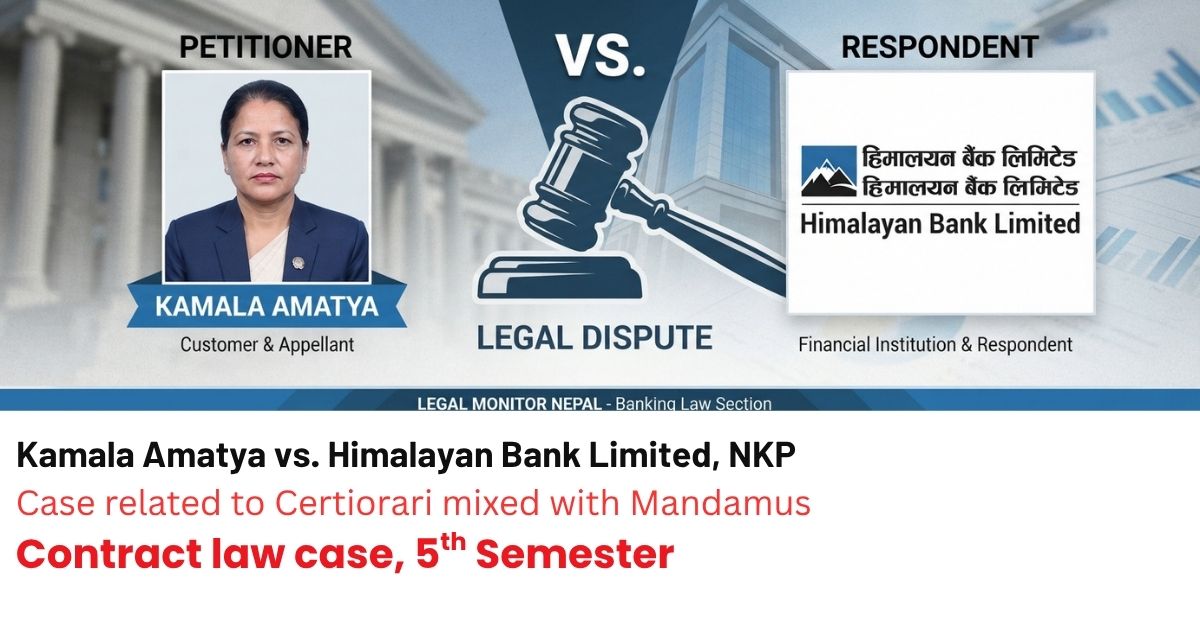
Contract Law Case: Kamala Amatya vs. Himalayan Bank Limited, et.al, NKP 2070 B.S, V.4
Case: Certiorari mixed with Mandamus
Petitioner: Kamala Amatya
Respondents: Himalayan Bank Limited, et.al
Decision No: 8997
This case is related to Personal liability arising from a guarantee given by a director
Facts of the Case:
Kamala Amatya was wife of Binod Bahadur Amatya, who was a director of Nepal Steel Pvt. Ltd. She, her husband, their son and daughter were members of the same family. Because she could no longer live jointly with her husband, Kamala executed a partition relinquishment deed on 2053/02/08 BS. Under that deed, she received land and a house in Lalitpur, including Kitta No. 164, measuring 2-3-2-0. She claimed that the property became her exclusive property and she had never mortgaged or given the property as security for any bank transaction. Later, she discovered that 1-3-2-0 of the property had been stopped by the Land Revenue Office at the request of Himalayan Bank Ltd. She therefore filed a writ petition seeking cancellation of the restriction and release of the property. The principal respondent was Himalayan Bank Ltd., along with the concerned Land Revenue Office. Nepal Steel Pvt. Ltd. had obtained loans from the bank. The company had mortgaged its own property as security. When the company failed to repay the loan, the bank auctioned the company’s mortgaged property but the entire loan was still not recovered. The bank then sought recovery from Binod Bahadur Amatya, who had given a personal guarantee for the company’s loan. The bank therefore stopped part of the property standing in the name of his wife, Kamala.
Plaintiff’s Claim:
Kamala argued that she had not borrowed any money from the bank and that the loan had been taken by Nepal Steel Pvt. Ltd., a separate legal entity whose debts should normally be recovered from its own property. She claimed that the disputed property had been obtained through partition from her husband and was her individual property, which she had neither personally guaranteed nor given as collateral for the company’s loan. She further argued that the bank stopped her property without giving her notice or an opportunity to be heard, violating her property rights and the principles of natural justice. Therefore, she requested Supreme Court to issue certiorari to quash the restrictions and mandamus to release the property.
Defendant’s Arguments:
Himalayan Bank Ltd. argued that Nepal Steel Pvt. Ltd. had taken substantial loans but failed to repay them. Although the company’s mortgaged property was auctioned the entire debt could not be recovered. The company’s director, Binod Bahadur Amatya, had personally guaranteed the loan so, the bank argued that it could recover the remaining debt from him according to the guarantee agreement. At the time of the loan and guarantee, Kamala and Binod were living together, and Kamala obtained the disputed property through partition only after the guarantee had been given. Therefore, the bank argued that the property could be stopped for recovery and that an alternative legal remedy was available against the restriction. Hence, the writ petition should be dismissed. Land Revenue Office argued that it had merely stopped the property pursuant to a lawful request or order from the competent authority. Since it was legally required to implement such an order, no unlawful act had been committed by the office. Therefore, the writ petition against the Land Revenue Office should also be dismissed.
Legal Issues:
- Can a bank recover a company’s unpaid debt from the property of a director or guarantor?
- Does the principle of limited liability protect a director who has personally guaranteed the company’s loan?
- Can property obtained by a wife through partition from her husband be stopped to satisfy the husband’s personal guarantee when the guarantee was given before the partition?
Decision of the Court:
Supreme Court: Supreme Court dismissed the writ petition, holding that although Nepal Steel Pvt. Ltd. had separate legal personality and limited liability, Binod Bahadur Amatya had personally guaranteed the company’s loan, making him contractually liable. Since he gave the guarantee while living jointly with Kamala and she acquired the disputed property through partition only later in 2059, the bank could stop the property for recovery of the guaranteed debt. Therefore, the restriction was held lawful and was not quashed.
Established Principles:
- Company has separate liability: A company is a separate legal entity from its directors and shareholders. Therefore, A company’s debt is recoverable from the company’s assets, not automatically from the personal property of its directors.
- Personal guarantee creates independent contractual liability: A personal guarantee creates a contractual obligation between the guarantor and the creditor. The liability of a guarantor arises from the guarantee contract, not merely from his position as a director.
- Guarantor’s property may be used for recovery: Where the company’s mortgaged property is insufficient to recover the loan and a person has provided a valid personal guarantee, the creditor may proceed against the guarantor according to the terms of the guarantee.
- Limited liability and guarantee are different legal concepts: Limited liability, liability arising from the company’s separate legal personality. Guarantee liability, liability voluntarily undertaken through a guarantee contract.