
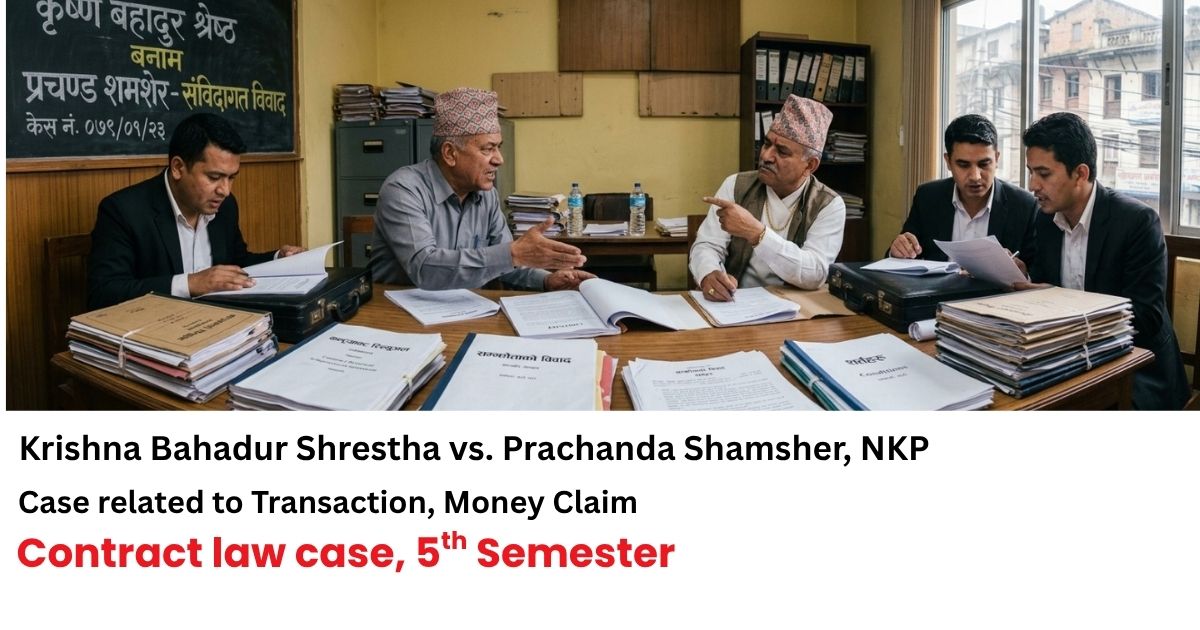
Contract law Case: Krishna Bahadur Shrestha vs. Prachanda Shamsher, NKP, 2025, N.4, P.80
Case: Transaction, Money Claim
Plaintiff: Krishna Bahadur Shrestha
Defendant: Prachanda Shamsher J.B.R
Decision No: 405
This case is related to money transaction deed.
Facts of the case:
Krishna Bahadur Shrestha, claimed that his grandmother Mohan Maya had been living under the care of defendant, Prachanda Shamsher J.B.R. Since there was no minor person in the household, plaintiff claimed that the gold and silver belonging to his grandmother were weighed and taken to the palace. The gold was stated to be 288 tola 8 masa and the silver 90 tola. According to plaintiff, the defendant had taken the property because it was required by the General Sahib and had made a written note regarding it. The grandmother gave that note to plaintiff near the end of her life in 2000 B.S, but plaintiff later lost it. Plaintiff further claimed that in 2003 B.S. his house was sold and Rs. 601/- also remained with defendant. The defendant had also arranged employment for him at Sundarijal. When plaintiff later requested payment, defendant allegedly replied through a letter dated 2010/01/15 BS that plaintiff’s property had been used up and that the amount would be paid within one to one-and-a-half years after calculating the accounts. On the basis of this letter, the plaintiff claimed Rs. 47,388.90/-, representing the value of the gold, silver, diamonds and house amount, and requested that the amount be recovered from the defendant. Defendant denied the claim and stated that he had supported plaintiff when the he was an orphan. He claimed that he had provided plaintiff with rice and cash every month for some time. He denied having written the alleged note and argued that plaintiff had created a false and forged document because defendant had stopped providing such support. Defendant also denied the signature on the letter produced by plaintiff and alleged that it was forged and fabricated.
Plaintiff’s claim:
Plaintiff claimed that his grandmother’s 288 tola 8 masa of gold and 90 tola of silver had been taken by defendant, Prachanda Shamsher J.B.R. He alleged that defendant had acknowledged responsibility through a written note and later through a letter dated 2010/01/15 BS, promising payment after calculation of the accounts. He also claimed Rs. 601/- from the sale of his house. Based on these claims, he sought recovery of Rs. 47,388.90/-.
Defendant’s Argument:
Defendant denied the claim and stated that he had previously supported plaintiff, who was an orphan, by providing rice and cash. He denied writing the alleged note and disputed the signature on the letter. He alleged that plaintiff had brought a false and forged claim after the financial support was stopped and therefore argued that plaintiff’s claim should be dismissed.
Legal Issues:
- Can a letter be admitted as legal evidence for recovery of money when, even if the letter is genuine, it does not specify a definite amount payable and does not state how much money remains due?
- When a document is legally incapable of proving the claim, does the court need to decide whether it is genuine or forged?
Decision of the courts:
Kathmandu District: District Court rejected plaintiff’s claim. The court compared defendant’s genuine signatures with the signature on the disputed letter and found significant differences in the writing and signatures. Therefore, it held that the document was forged and could not support plaintiff’s claim.
Appellate Court: Court upheld the decision of the original court. It agreed that the disputed document was not reliable and that plaintiff had failed to establish his claim for recovery of the amount.
Supreme Court Division Bench: It also agreed that the disputed document was forged after comparing it with defendant’s genuine signatures in other official records. However, it found that the punishment imposed under the provision relating to jalsaji was inappropriate and modified that part of the decision.
Judicial Committee: Judicial Committee agreed that the letter could not properly establish plaintiff’s money claim. It observed that, even if the letter were genuine, the amount had to be determined from the terms actually stated in the letter rather than from plaintiff’s total claim of Rs. 47,388.90/- It therefore recommended that the case be reviewed.
Supreme Court (Full Bench): Full Bench ultimately held that the letter could not be used to recover the claimed amount because it did not specify a definite amount payable or the amount remaining due. It could not therefore serve as a valid transaction or security document. Since the letter was legally insufficient to prove the claim even if genuine, Court held that there was no need to determine whether it was genuine or forged. Thus, the plaintiff’s claim for recovery of money failed.
Established Principles:
- A definite amount is important in a money transaction document: Court held that the letter could not be treated as a proper security document because it did not fulfill the required legal conditions. It also could not be treated as a proper transaction document because there was no definite amount stated in the document.
- No need to decide genuine or forged when document is legally inadmissible: once the document was found incapable of being legally accepted as evidence for the money claim, it was unnecessary to decide whether the document was genuine or forged.
- Evidence must have legal relevance and effect: A document is not automatically useful evidence simply because it exists or contains some acknowledgment. It must have the legal capacity to establish the right claimed by the party relying upon it.