

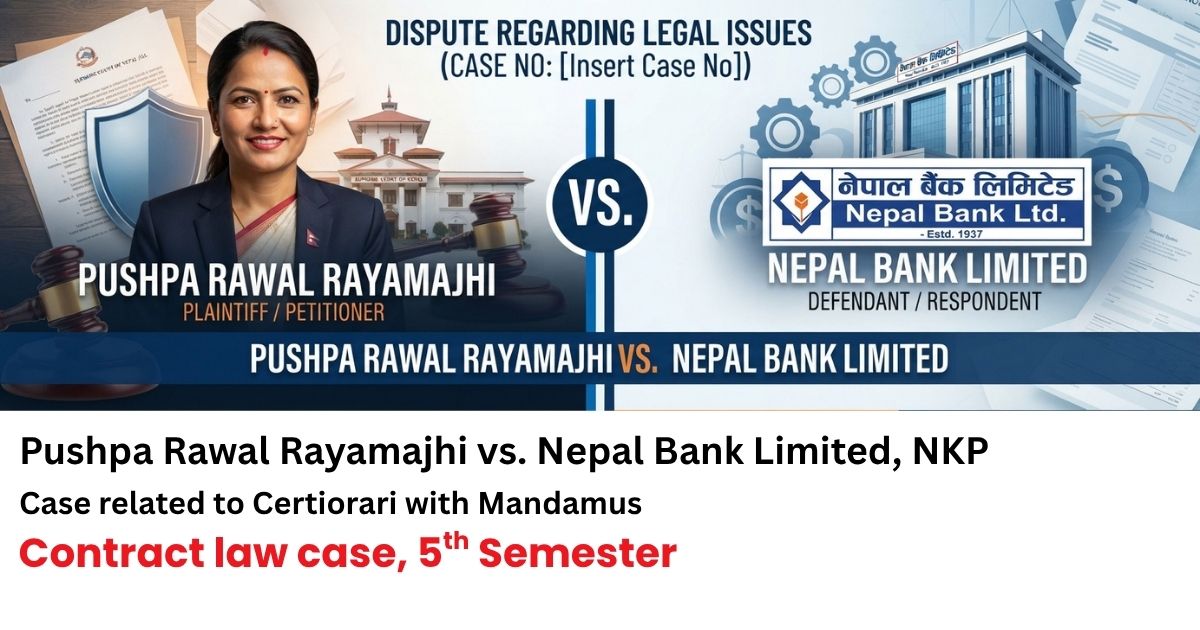
Contract Law Case: Pushpa Rawal Rayamajhi vs. Nepal Bank Limited, Central Office et.al, NKP 2069 B.S, V.7,
Case: Certiorari with Mandamus
Petitioner: Pushpa Rawal Rayamajhi
Respondents: Nepal Bank Limited, Central Office and others
Decision No: 8861
This case is related to surety, legal effect of acceptance of a bid in an auction of mortgaged property
Facts of the Case:
Mishrilal Chaudhary had obtained a loan from Nepal Bank Limited by mortgaging his land and building located in Itahari, Sunsari. He failed to repay the loan, and the ordered that the mortgaged property be auctioned to recover the bank’s outstanding loan. The minimum value of the property was fixed at Rs.1,73,12,848/- and an auction notice was published. The petitioner, Pushpa Rawal Rayamajhi, submitted a bid of Rs. 1,73,13,448/- and deposited approximately 10% of the bid amount as security/earnest money. Her bid was accepted by the Debt Recovery Officer, and she was required to deposit the remaining amount within 15 days. However, before she paid the remaining amount and before the property was transferred into her name, the original borrower, Mishrilal Chaudhary, approached the bank and arranged to settle the entire outstanding loan. The bank accepted the amount paid by Mishrilal and informed the Debt Recovery Tribunal that the loan had been fully settled. The bank also requested release of the mortgaged property. The petitioner objected, arguing that because her bid had already been accepted and she had deposited the required security amount, she had acquired a legal right over the property.
Petitioner’s Claim:
Petitioner claimed that her bid had been properly accepted by the Debt Recovery Officer and that she had already deposited the required 10% amount as security. Therefore, according to her, the auction process had effectively reached its final stage and a legal right over the property had arisen in her favour. She argued that the borrower could no longer repay the loan and prevent the property from being transferred to her. She further argued that the authorities should complete the remaining auction procedure, collect the balance amount from her and register the property in her name. Therefore, she sought an order quashing the decision of the Debt Recovery Appellate Tribunal and a mandamus directing the concerned authority to register the property in her name.
Respondent’s arguments:
Mishrilal Chaudhary: Mishrilal argued that petitioner’s bid had not completed the auction process. She had only deposited the 10% earnest money and had not paid the remaining 90% of the bid amount. The property had also not been registered or transferred into her name. Therefore, no legal right had been created in her favour. He further argued that he had repaid the entire outstanding loan before the auction process was completed. Therefore, he was entitled to recover his property.
Argument of Nepal Bank Limited: The bank argued that Mishrilal had fully settled his outstanding loan after discussions with the bank. The bank had received Rs. 1,73,13,500/- through cash and a good for payment cheque and had requested the Debt Recovery Tribunal to stop the execution proceedings and release the mortgaged property. Since the loan had been completely settled, there was no remaining dispute between the bank and the borrower. Therefore, petitioner’s legal rights had not been violated.
Argument of the Debt Recovery Tribunal: The Tribunal argued that although petitioner’s bid had been accepted, the auction process had not yet been completed. The bidder had not paid the full bid amount, and the property had not been registered in her name. Therefore, petitioner did not have an established legal right over the property.
Legal Issues:
- Does a bidder acquire a legal right over auctioned property merely because the bid has been accepted?
- After an auction, can borrower still repay the loan before the auction process is completely finished?
Decision of the Court:
Supreme Court: Court held that petitioner’s bid was accepted, but she had paid only 10% of the required earnest money. She had not paid the remaining 90%, and the property had not yet been transferred or registered in her name. Therefore, the auction was not yet complete, and she had no legally established right over the property. Before the auction was completed, Mishrilal had the right to repay his loan and recover his property. He paid the entire outstanding loan, and the bank accepted the payment. Therefore, the auction could legally be stopped. The Court held that petitioner’s claimed right was only future and conditional, not an existing legal right. A writ cannot normally be used to protect a mere potential or future right. Therefore, court refused to cancel the Debt Recovery Appellate Tribunal’s order and dismissed the writ petition.
Established Principles:
- Acceptance of a bid does not by itself transfer ownership: Court held that merely accepting a bid does not automatically create ownership or a final legal right over the auctioned immovable property.
- A security deposit does not create ownership: The 10% amount deposited by petitioner was only earnest money under the terms of the bid. It was not the full purchase price and therefore did not itself create ownership or a completed property right.
- Contractual or auction rights are different from established property rights