

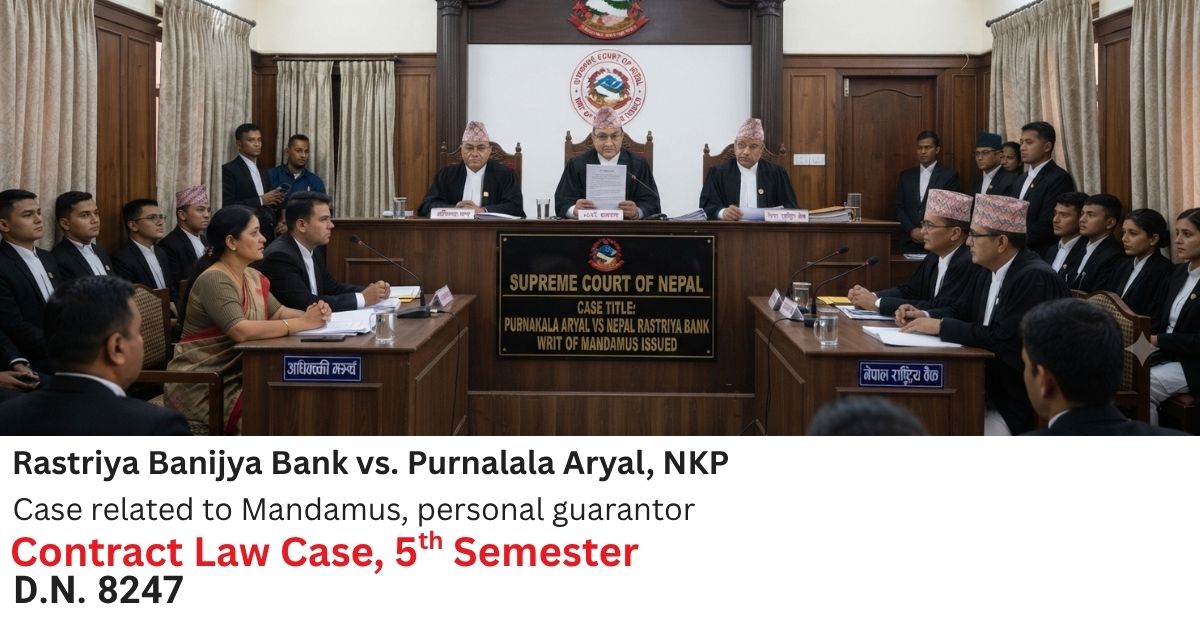
Contract Law Case: Rastriya Banijya Bank vs. Purnalala Aryal, NKP 2066, No. 10, P. 1705. D. No. 8247.
Case: Mandamus, personal guarantor
Plaintiff: Purnakala Aryal
Defendant: Rastriya Banijya Bank, Mahendranagar Branch, and others.
Decision Number: 8247
This case is related to Mandamus and personal guarantor of loan.
Facts of the Case:
Purnakala Aryal obtained two service loans from Rastriya Banijya Bank by mortgaging her own land and house. She deposited a total of Rs. 13,17,988.70/- with the bank. After deducting her own outstanding loan and interest amounting to Rs. 10,91,338.98/- bank released her mortgage property and remaining Rs. 2,26,649.72/- should have been returned to her. However, the bank refused to release this remaining amount because Purnakala Aryal had previously signed as a personal guarantor for the loan of Paras Movie Centre (Proprietor: Bimal Aryal). Since that loan had not yet been repaid, the bank froze her remaining money. Claiming that this was illegal and violated her legal rights, she filed a writ petition seeking a mandamus directing the bank to return her money.
Plaintiff’s Claim:
Plaintiff argued that she had already fully repaid her own loan and remaining amount belonged to her and should have been returned immediately. The bank illegally withheld her money because of another person’s unpaid loan. The borrower had already provided separate mortgaged property, so the bank should recover its loan from that security instead of freezing her money. The bank’s action violated her constitutional and legal rights to property. Therefore, the court should issue a writ of mandamus ordering the bank to release her money.
Defendant’s Arguments:
The bank argued that Purnakala Aryal had voluntarily signed a personal guarantee for Bimal Aryal’s loan of Rs. 5,00,000/- The guarantee document clearly stated that if the borrower failed to repay, she would also be responsible. The borrower repeatedly failed to repay despite several notices. Under the guarantee agreement and the law relating to recovery of bank loans, the bank was legally entitled to recover the loan from the guarantor. Therefore, freezing her money was lawful. Since the dispute related to loan recovery, a writ of mandamus could not be issued.
Legal Issues:
- Can a bank legally freeze the account or money of a personal guarantor when the principal borrower has not repaid the loan?
- Does a guarantor remain legally liable after the borrower’s default?
- Is a writ of mandamus available in a private loan recovery dispute between a bank and a guarantor?
Decisions of the Courts:
Mahendranagar Appellate Court: Appellate Court allowed the writ petition and stated that the bank had not clearly established how much remained unpaid under the other loan. Since plaintiff had already repaid her own loan, the remaining money should have been returned, freezing her money without properly determining liability was contrary to law. Therefore, court issued a writ of mandamus directing the bank to return Rs. 2,26,649.72/-
Supreme Court: Supreme Court allowed the bank’s appeal and reversed Appellate Court’s judgment, and dismissed the writ petition and stated plaintiff had voluntarily executed a personal guarantee, A guarantor is legally responsible if the borrower fails to repay. The guarantee document expressly allowed the bank to recover the unpaid amount from the guarantor’s movable and immovable property. Under Section 2(6) of the Bank and Financial Institutions Loan Recovery Act, 2063, a guarantor is included within the definition of a debtor. Therefore, the bank acted within its legal authority by freezing her money.
Established Principles:
- A guarantor cannot escape liability simply because the borrower has provided separate collateral.
- Under the Bank and Financial Institutions Loan Recovery Act, a guarantor is treated as a debtor for loan recovery purposes.
- A bank may lawfully recover unpaid loans from a guarantor according to the guarantee agreement.
- A writ of mandamus cannot be used to resolve ordinary contractual or loan recovery disputes.
- Mandamus is issued only when a public authority fails to perform a legal duty imposed by law.
- Courts should not issue writs casually in disputes arising from contractual obligations, as doing so weakens the constitutional purpose of the writ jurisdiction.
Legal Doctrines:
- Doctrine of Guarantee (Suretyship): A guarantor becomes legally responsible for repayment when the principal debtor defaults.
- Doctrine of Contractual Liability: A person who voluntarily signs a guarantee is bound by its terms.