

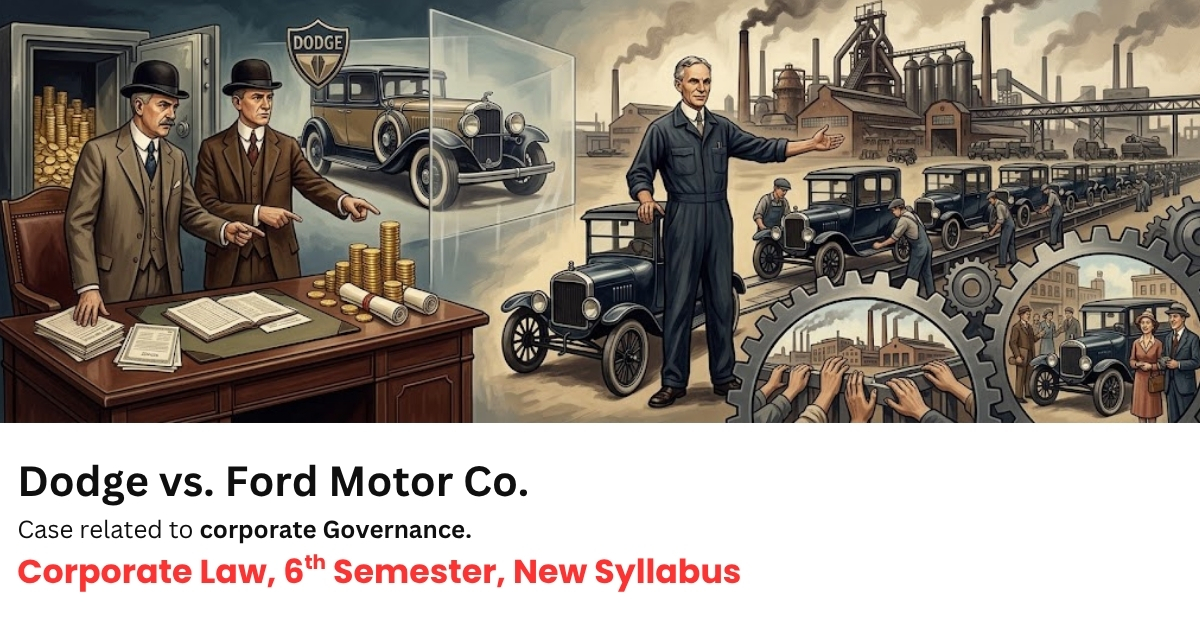
Corporate Law Case: Dodge vs. Ford Motor Co., 204 Mich. 459, 170 N.W. 668 (1919).
Case: Relating to Corporate Governance
Plaintiff: John and Horace Dodge (the Dodge brothers)
Defendant: Ford Motor Company
Case citation: 204 Mich. 459, 170 N.W. 668 (1919).
The case is relating to the duties of directors, shareholder rights, dividend policy, business judgment, and the purpose of a business corporation.
Facts of the Case:
The Dodge brothers owned about 10% of Ford Motor Company, while Henry Ford controlled about 58% of the company.
Ford Motor Company had accumulated a very large surplus through its profitable operations and had regularly paid dividends, including large special dividends.
Henry Ford later decided to stop paying special dividends and instead reinvest most of the company’s profits into the business. The company planned to reduce car prices, expand its manufacturing facilities, and build a large plant at River Rouge to produce its own iron and steel.
Ford stated that the purpose of the expansion was not only to benefit the company but also to employ more people, reduce prices for customers, and make the benefits of the business available to a larger number of people.
The Dodge brothers wanted the company to distribute more of its profits as dividends. They therefore challenged Ford’s decision and sought a special dividend and restrictions on the company’s expansion plans.
Legal Issues:
- Whether the company’s investment in the River Rouge plant was beyond its corporate powers.
- Whether courts can interfere with directors’ decisions regarding business expansion and investment.
- Whether the directors refusal to pay a special dividend was an abuse of their discretion.
- Whether a business corporation can prioritize the interests of employees, customers, or the public over the interests of its shareholders.
Decision of the Court:
The Court held that the River Rouge smelting operation (extracting metal from its ore by heating it at a high temperature) was within Ford Motor Company’s corporate powers. Producing its own iron and steel was reasonably connected with the company’s automobile manufacturing business and was therefore not ultra vires.
The Court also recognized the business judgment rule. Directors generally have discretion over matters such as business expansion, investment, pricing, wages, and the use of corporate profits. Courts should not interfere with such decisions unless there is fraud, bad faith, or a clear abuse of discretion.
However, the Court found that Ford’s refusal to pay any special dividend was an abuse of discretion. The company had a very large surplus, was highly profitable, and could finance its planned expansion while still retaining substantial funds. The Court therefore ordered Ford Motor Company to pay approximately $19.3 million as a special dividend.
The Court emphasized that a business corporation is primarily established to generate profit for its shareholders. Directors cannot deliberately manage the corporation mainly for the benefit of employees, customers, or the public while treating shareholder interests as merely incidental.
The Court therefore allowed Ford’s expansion plans to continue but ordered the payment of the special dividend.
Principles Established:
- A business corporation is primarily operated for the profit of its shareholders.
- Directors have broad discretion to make business decisions, including expansion, investment, pricing, and dividend policies.
- Courts generally do not interfere with directors’ business decisions unless there is fraud, bad faith, or abuse of discretion.
- Directors cannot arbitrarily withhold profits that should reasonably be distributed to shareholders.
- Directors cannot sacrifice shareholder interests merely to pursue broader social or public objectives.
- An activity reasonably connected with the corporation’s business purpose is not necessarily ultra vires.