
Corporate Law Case: Salomon vs. A. Salomon & Co. Ltd. [1897] A.C. 22 (H.L.)
Case: Separate Legal Personality
Plaintiff: Aron Salomon
Defendant: Salomon & Co. Ltd. / Liquidator
Case citation: [1897] A.C. 22 (H.L.)
This case is related to Separate Legal Personality.
Facts of the Case:
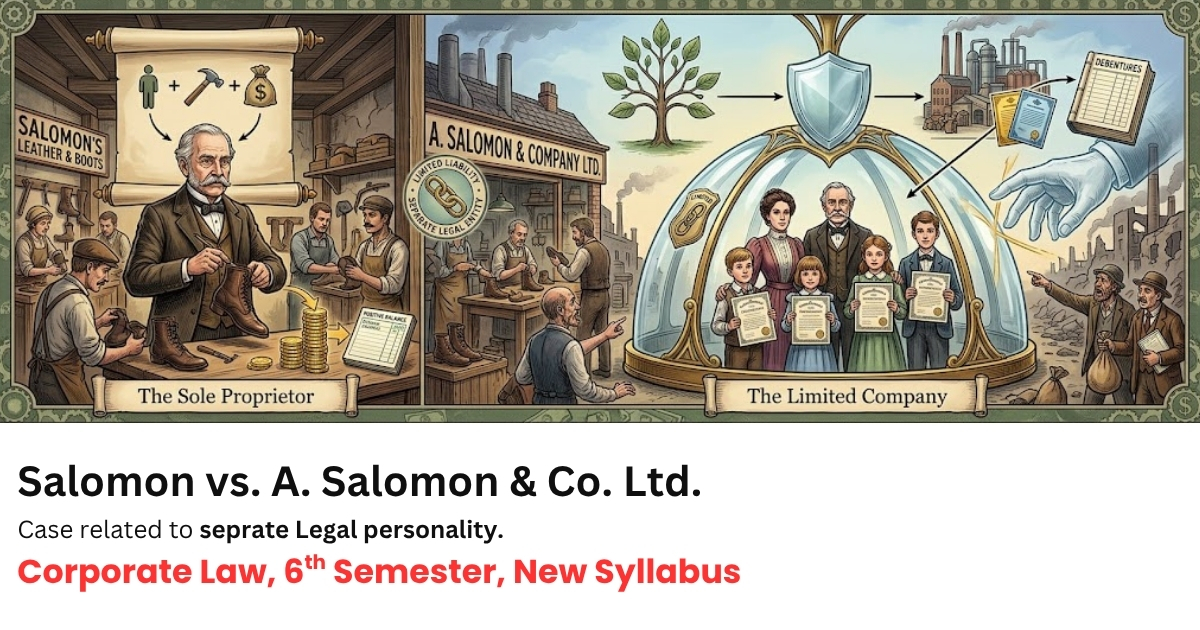
Aron Salomon had operated a successful leather and boot business for many years. He later decided to convert the business into a limited company.
He formed A. Salomon and Company Ltd. with seven shareholders. Salomon, his wife and his five children each held shares. Salomon held almost all the shares and controlled the company.
The company purchased Salomon’s existing business from him. As part of the payment, the company gave Salomon shares and secured debentures. Salomon also lent money to the company when it faced financial difficulties.
The company later became insolvent and went into liquidation. After paying the secured creditor, there was not enough money to pay the unsecured creditors. The liquidator argued that Salomon should personally pay the company’s debts because the company was only a sham or agent of Salomon.
Legal Issues:
- Whether the company was properly incorporated despite Salomon holding almost all the shares.
- Whether the company was merely an agent or representative of Salomon.
- Whether Salomon was personally liable for the company’s debts.
Decision of the Court:
The House of Lords ruled in favour of Salomon and reversed the decisions of the lower courts.
The Court held that the company was properly incorporated under the Companies Act. Once incorporated, it became a separate legal person from Salomon and its other shareholders.
The fact that Salomon controlled almost all the shares did not change the company’s separate legal identity. The company was not his agent or trustee.
Therefore, Salomon was not personally liable for the company’s debts. The creditors had dealt with the company as a limited company and had to accept the legal consequences of that arrangement.
Principles Established:
- A properly incorporated company is a separate legal person from its shareholders.
- A company’s debts are generally its own debts, not the personal debts of its shareholders.
- A shareholder may control almost all of a company’s shares without losing the company’s separate legal identity.
- The company is not automatically an agent or trustee of its shareholders.
- The principle of separate legal personality applies even where one person has almost complete control of the company.