
Evidence Law Case: Bir Bahadur Bot v. Government of Nepal, NKP 2078 B.S., Vol.11, DN: 10773
Case: Culpable Homicide
Plaintiff: Government of Nepal on the complaint of Ram Krishna Bot
Defendant: Bir Bahadur Bot, Bhawani Chand, Urmila Bot
Decision Number: 10773
This case is related to the evidentiary value of dying declarations in murder cases, the admissibility of digital and audio evidence, the assessment of corroborative evidence, and the principle that a trustworthy dying declaration can sustain a conviction even without direct eyewitness testimony.
Facts of the Case:
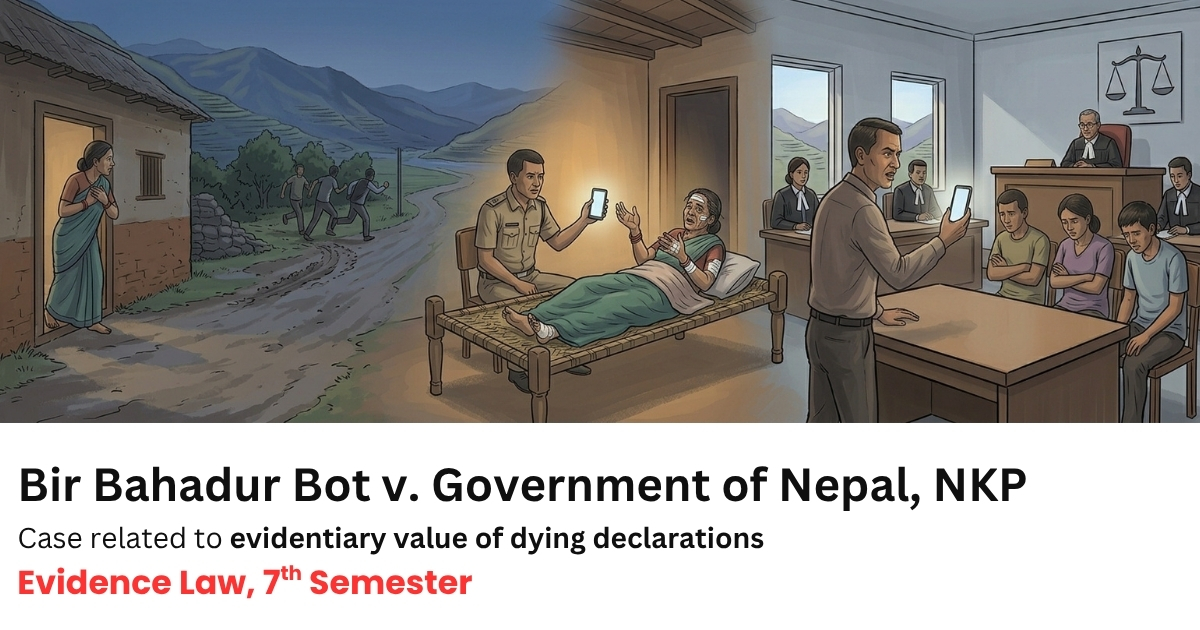
Ramlalli Bot was called outside her house late at night by someone calling her “Bhauju.” Shortly after going outside, she cried for help, saying that someone was dragging her. Hearing her screams, her daughter-in-law rushed outside and found Ramlalli lying injured near the house. She also saw three people running away in the darkness but could not identify them.
Ramlalli was taken for medical treatment but died a few days later while being taken to another hospital. Before her death, a police officer recorded her statement on his mobile phone. In that statement, Ramlalli said that the voice calling her sounded like Bhawani Chand’s and that Virbahadur Bot and Urmila Bot had caught and assaulted her. The prosecution also alleged that the incident was connected to a long-standing land dispute between the victim’s family and Virbahadur’s family.
The post-mortem report could not determine the exact cause of death and noted that the deceased also suffered from chronic health problems. All three accused denied the allegations. Virbahadur Bot and Urmila Bot claimed they were at home when the incident occurred, while Bhawani Chand stated that he was attending a religious gathering at the relevant time and had no involvement in the incident.
Legal Issues:
1. Whether a voice recording made by a police officer on a mobile phone is admissible as a valid dying declaration.
2. Whether a dying declaration translated from a local language can be relied upon as evidence.
3. Whether the evidence was sufficient to convict all the accused beyond reasonable doubt.
4. Whether Bhawani Chand’s involvement was proved beyond reasonable doubt.
Decisions of the Courts:
Kanchanpur District Court:
The District Court convicted all three accused of murder and sentenced them to life imprisonment with confiscation of property.
Dipayal High Court (Mahendranagar Bench):
The High Court upheld the conviction of Virbahadur Bot and Urmila Bot but acquitted Bhawani Chand, holding that the evidence against him was insufficient.
Supreme Court Decision:
The Supreme Court upheld the conviction of Virbahadur Bot and Urmila Bot and also upheld the acquittal of Bhawani Chand.
The Court held that the voice recording made by the investigating police officer was a valid dying declaration. It observed that a dying declaration does not become inadmissible simply because it is recorded on a mobile phone or translated from a local language. As long as its authenticity is established and there is no serious challenge to its accuracy, it can be relied upon as evidence.
It also recognized that audio recordings have evidentiary value as documentary evidence.
The Court found that the dying declaration, along with the testimony of the daughter-in-law and the surrounding circumstances, was sufficient to prove the guilt of Virbahadur Bot and Urmila Bot. However, the evidence against Bhawani Chand was not strong enough. The deceased had only said that the voice “sounded like” his, and there was no independent evidence directly linking him to the assault. His plea that he was attending a religious gathering at the relevant time was also supported by witnesses.
The Court further held that, under the new Criminal Code, confiscation of property was no longer applicable as part of a life imprisonment sentence. Therefore, it upheld the conviction of Virbahadur Bot and Urmila Bot with the modified sentence, while dismissing the Government’s appeal against Bhawani Chand’s acquittal.
Principle Established:
• A dying declaration recorded on a mobile phone can be admissible evidence if its authenticity is proved.
• Audio or digital recordings have evidentiary value as documentary evidence.
• A translated dying declaration may be relied upon when its accuracy is not effectively challenged.
• A person cannot be convicted on mere suspicion; the prosecution must prove guilt beyond reasonable doubt.