

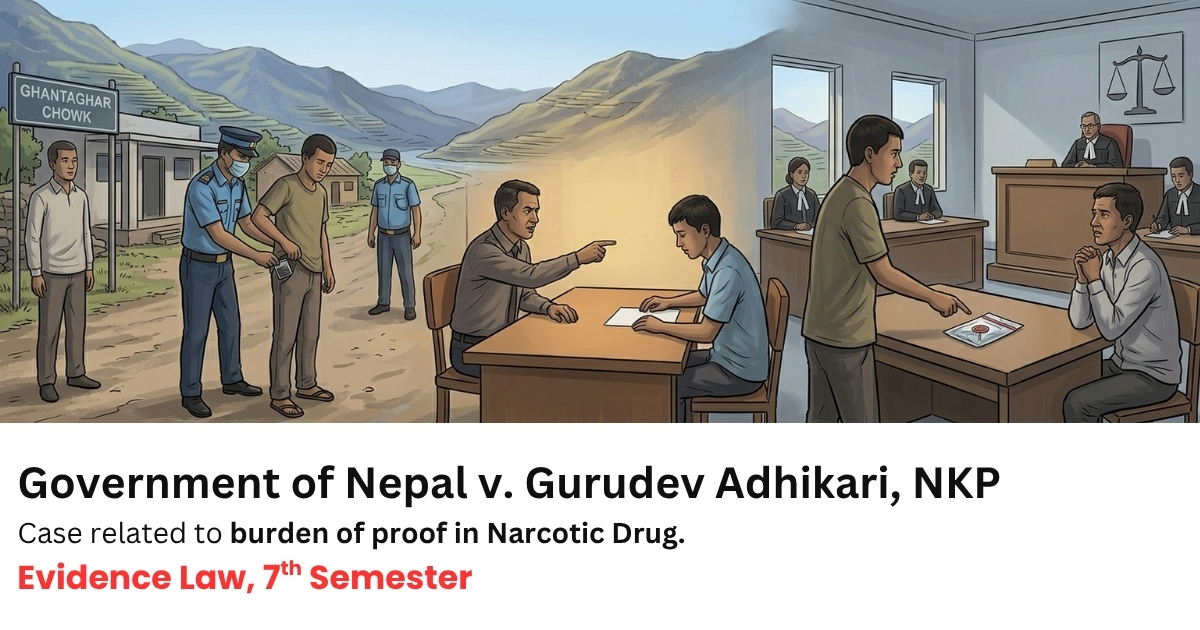
Evidence Law Case: Government of Nepal v. Gurudev Adhikari, NKP 2079 B.S., Vol.6, DN: 10891
Case: Drug Trafficking
Plaintiff: Government of Nepal on the complaint of Pradip Prasad Jaiswal
Defendant: Gurudev Adhikari and Buddha Pariyar
Decision Number: 10891
This case is related to the burden of proof in narcotics offences, the evidentiary value of a co-accused’s confession, individual criminal liability, and the principle that mere presence or association with a person possessing narcotic drugs is insufficient to establish guilt beyond reasonable doubt.
Facts of the Case:
Police officers conducting a routine search at Ghantaghar Chowk, Birgunj, stopped Gurudev Adhikari and Buddha Pariyar while they were walking together. During the search, 13 grams of brown heroin was recovered from the front pocket of Buddha Pariyar’s trousers. No narcotic substance or any other incriminating material was found on Gurudev Adhikari.
During the investigation, both accused admitted that they had travelled together to Raxaul, India, purchased the heroin, and intended to use part of it and sell the remainder. However, during the trial, both retracted their earlier statements. Gurudev denied any involvement in the purchase or possession of the drugs, claiming that he had met Buddha by chance while returning home.
Buddha also stated that the heroin belonged solely to him and that Gurudev had no knowledge that he was carrying it.
The prosecution alleged that Gurudev was equally involved in the offence because both accused had travelled together and had initially confessed during the investigation. Gurudev, however, maintained that he was merely accompanying a fellow villager and had no connection with the narcotic substance.
Legal Issues:
1. Whether the prosecution must still prove guilt beyond reasonable doubt in narcotics cases despite the statutory burden on the accused.
2. Whether the retracted confession of a co-accused is sufficient to convict another accused.
3. Whether mere presence with a person carrying narcotic drugs is sufficient to establish criminal liability.
4. Whether Gurudev Adhikari’s involvement in the offence was proved beyond reasonable doubt.
Decisions of the Courts:
Parsa District Court:
The District Court acquitted Gurudev Adhikari due to lack of evidence linking him to the narcotic substance. Buddha Pariyar was convicted under the Narcotic Drugs (Control) Act, 2033, and sentenced to 7 years’ imprisonment with a fine of Rs. 10,000.
Janakpur High Court (Birgunj Bench):
The High Court upheld Gurudev Adhikari’s acquittal. It reduced Buddha Pariyar’s sentence from 7 years to 6 years’ imprisonment, while maintaining the Rs. 10,000 fine.
Supreme Court Decision:
The Supreme Court dismissed the Government’s appeal and upheld Gurudev Adhikari’s acquittal. The Court observed that no narcotic substance was recovered from Gurudev and that there was no independent evidence proving that he had purchased, possessed, or trafficked the heroin.
The Court held that the retracted statements made during police investigation, without corroborating evidence, were insufficient to establish Gurudev’s guilt. It further observed that both accused consistently stated before the Court that Gurudev had no knowledge of the heroin carried by Buddha, and this version was also supported by defence evidence.
The Court clarified that although the Narcotic Drugs (Control) Act places a limited burden on an accused person, the primary burden of proving the offence beyond reasonable doubt always remains with the prosecution. Mere suspicion or the fact that a person was accompanying another accused cannot by itself justify a conviction. As the prosecution failed to establish Gurudev’s involvement through reliable evidence, his acquittal was affirmed.
Principle Established:
• The prosecution bears the primary burden of proving guilt beyond reasonable doubt, even in offences under the Narcotic Drugs (Control) Act.
• A retracted confession of a co-accused, without independent corroboration, is insufficient to convict another accused.
• Mere presence or association with a person possessing narcotic drugs does not establish criminal liability.
• Criminal conviction cannot be based on suspicion; it must be supported by reliable and convincing evidence.