

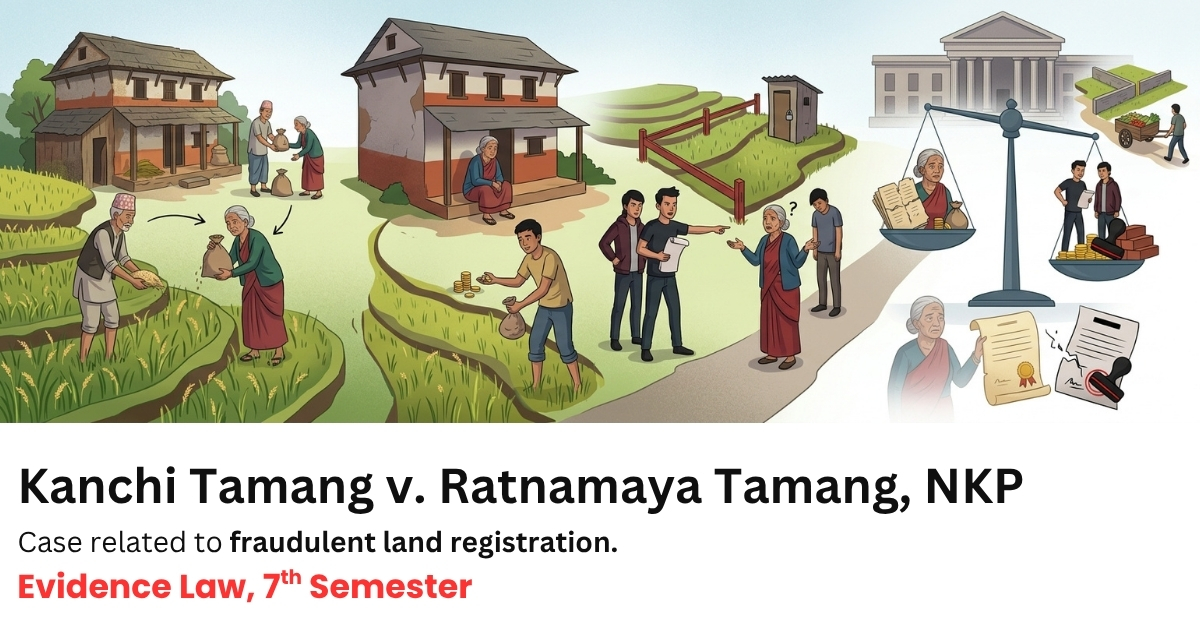
Evidence Law Case: Kanchi Tamang v. Ratnamaya Tamang, NKP 2076 B.S., Vol.1, DN: 10164
Case: Registration Cancellation
Plaintiff: Ratnamaya Shakya
Defendant: Kanchi Tamang et.al.
Decision Number: 10164
This case is related to fraudulent land registration, the doctrine of estoppel, the effect of limitation in cases involving fraud, and the principle that a fraudulent registration can be cancelled once fraud is proved, even after the ordinary limitation period has expired.
Facts of the Case:
Ratnamaya Shakya claimed that the disputed land originally belonged to her late husband. After his death, the land continued to be cultivated by a tenant, Punte Tamang, who regularly paid rent to Ratnamaya’s family. After Punte’s death, his heirs also continued paying rent for some time.
Later, the defendants stopped paying rent. When Ratnamaya looked into the matter, she found that they had registered the land in their own names and had even sold part of it. She alleged that the registration had been obtained fraudulently by using an unrelated old land record that had no connection with the disputed property. She therefore filed a suit seeking cancellation of the registration.
The defendants denied the claim and argued that the land belonged to their family. They also contended that the registration had been completed years earlier and that Ratnamaya had filed the case after the legal limitation period had expired. In response, Ratnamaya relied on an earlier court decision involving the same land, in which part of the disputed registration had already been cancelled in favour of her family.
Legal Issues:
1. Whether a fraudulent land registration can be challenged after the limitation period.
2. Whether the defendants could claim ownership despite their predecessor admitting he was only a tenant.
3. Whether the earlier final judgment on the same land was binding.
4. Whether proving fraud alone is enough to cancel a land registration.
Decisions of Different Courts:
Kathmandu District Court:
The District Court dismissed the case, holding that it had been filed beyond the prescribed limitation period.
Patan Appeal Court:
The Appeal Court reversed the District Court’s decision. It held that the registration had been obtained fraudulently and cancelled it, confirming Ratnamaya’s ownership over her share of the land.
Supreme Court Decision:
The Supreme Court upheld the Appeal Court’s judgment. It held that the defendants could not claim ownership because their predecessor had long accepted that he was only a tenant and had regularly paid rent to Ratnamaya’s family. The Court observed that the defendants were bound by that admission and could not later take a contradictory position.
The Court also found that the old land record relied upon by the defendants had no connection with the disputed property and could not support their claim. It further held that the earlier final judgment concerning the same registration had already settled part of the dispute and could not be ignored.
Regarding limitation, the Court ruled that a fraudulent registration cannot be protected merely because time has passed. Once fraud is proved, the registration can be cancelled through the court without requiring any separate legal procedure. Accordingly, the defendants’ appeal was dismissed, and the cancellation of the disputed registration was upheld.
Principle Established:
• A fraudulent land registration can be cancelled even after the ordinary limitation period.
• A party cannot take a position contrary to the admissions made by their predecessor.
• A final judgment on the same issue is binding in later proceedings.
• Fraud proved before the court is sufficient to cancel an unlawful land registration.