

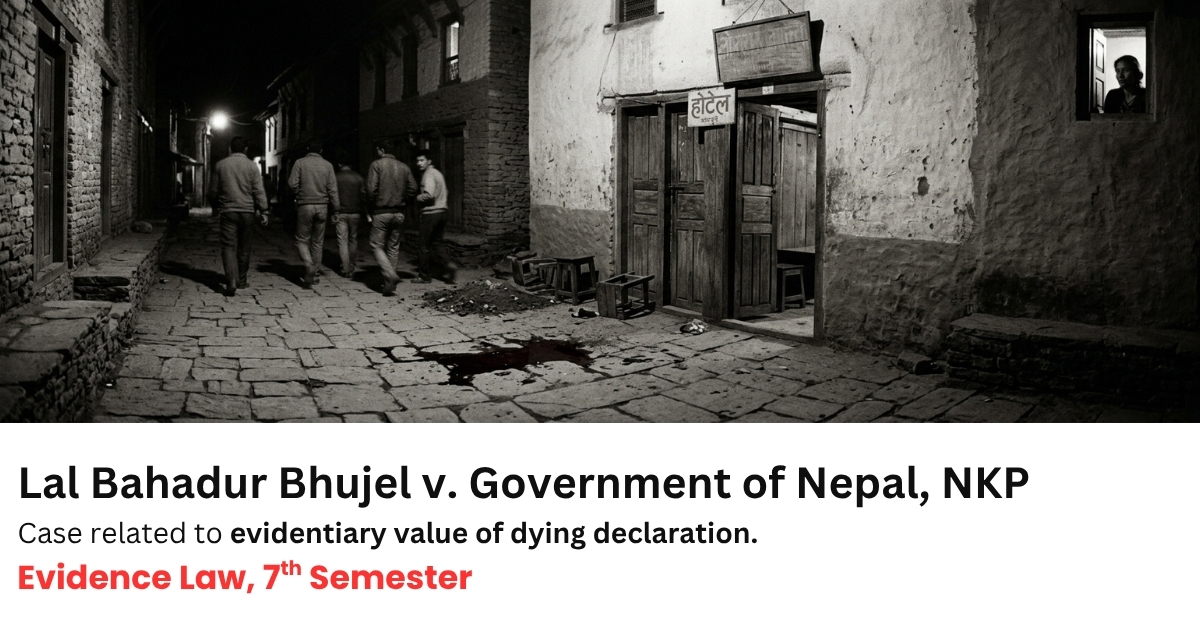
Evidence Law Case: Lal Bahadur Bhujel v. Government of Nepal, NKP 2079 B.S., Vol.1, DN: 10810
Case: Culpable Homicide
Plaintiff: Government of Nepal on the complaint of Shakuntala Karki
Defendants: Nawaraj Basnet, Yadunath Ghimire, Tikaram Bhujel, and Bimarshraj Ghimire et.al
Decision Number: 10810
This case is related to the evidentiary value of dying declarations and confessional statements, joint criminal liability in murder, criminal conspiracy, and the principle that mere suspicion or presence at the scene is insufficient to establish guilt without reliable supporting evidence.
Facts of the Case:
Chhabilal Karki was having dinner at a hotel in Nishankhe Bazar, Okhaldhunga, with his friends Devbahadur Katwal and Dilbahadur Sarki. A group of men entered the hotel and jointly attacked him with various weapons. They dragged him outside and continued the assault, while his two friends fled from the scene. Chhabilal was taken to the hospital but died due to excessive bleeding caused by multiple injuries.
Before his death, Chhabilal identified the persons who had attacked him, including Nawaraj Basnet, Yadunath Ghimire, Tikaram Bhujel, and Bimarshraj Ghimire. His wife also alleged that Chhabilal’s elder brother, Chandrakumar Karki, had planned the murder because of long-standing family and political disputes. During the investigation, some accused confessed to participating in the assault, while Chandrakumar admitted that he had paid Nawaraj Basnet after being informed that the murder had been carried out. Other accused denied their involvement and claimed false implication.
Legal Issues:
1. Whether the prosecution proved the guilt of the accused.
2. Whether the dying declaration and confessional statements were reliable evidence.
3. Whether all participants were jointly liable for the murder.
4. Whether mere presence or being named in the FIR was sufficient to establish guilt.
Decision of the Courts:
Okhaldhunga District Court:
The District Court convicted Nawaraj Basnet, Yadunath Ghimire, Bimarshraj Ghimire, Tikaram Bhujel, and Chandrakumar Karki and sentenced each to life imprisonment. It convicted Lalbahadur Bhujel, Devbahadur Katwal, and Dilbahadur Sarki and sentenced each to 3 years’ imprisonment. Om Kumar Rai was acquitted due to insufficient evidence.
Rajbiraj Appellate Court:
The Appeal Court sentenced Nawaraj Basnet, Yadunath Ghimire, Bimarshraj Ghimire, Tikaram Bhujel, and Chandrakumar Karki to life imprisonment. It acquitted Devbahadur Katwal and Dilbahadur Sarki, sentenced Lalbahadur Bhujel to three years’ imprisonment, and acquitted Om Kumar Rai due to insufficient evidence.
Supreme Court Decision:
The Supreme Court held that Chhabilal’s dying declaration was reliable as it was consistent with the medical evidence and witness testimony. It also held that the confessions of Nawaraj Basnet, Yadunath Ghimire, Bimarshraj Ghimire, and Tikaram Bhujel were supported by independent evidence and rightly relied upon. Since they had jointly attacked the victim, all were equally liable for the murder, and their life sentences were upheld.
The Court further held that Chandrakumar Karki, although he did not personally assault the victim, had planned, financed, and consented to the murder. Therefore, he was equally liable and his life sentence was upheld.
The Court found that there was no reliable evidence showing that Devbahadur Katwal and Dilbahadur Sarki participated in the attack, and merely being named in the FIR or being present at the scene was insufficient to convict them. Their acquittal was upheld. It also held that merely attending planning meetings did not prove Lalbahadur Bhujel’s participation in the murder, and he was acquitted by giving him the benefit of the doubt. Om Kumar Rai’s acquittal was also upheld because there was reasonable doubt regarding his identity.
Principle Established:
A dying declaration is reliable if it is voluntary, trustworthy, and supported by other evidence.
• A confession made during investigation may be relied upon if it is corroborated by independent evidence.
• When several persons jointly commit a murder and the person causing the fatal injury cannot be identified, all participants are equally liable.
• Mere suspicion, presence at the scene, attendance at planning meetings, or being named in the FIR is not enough to establish criminal liability without supporting evidence.
• A person who plans, finances, or consents to the commission of a murder is equally liable as the actual offender.