

Evidence Law Case: Pushkar Gautam vs Government of Nepal, NKP 2080 B.S., Vol. 6, DN: 11103
Case: Culpable Homicide
Plaintiff: Government of Nepal on the complaint of Ganesh Kumar Shrestha
Defendant: Pushkar Gautam et.al.
Decision Number: 11103
This case is related to the burden of proof in criminal cases, appreciation of eyewitness and circumstantial evidence, conviction without recovery of the dead body, and proof beyond reasonable doubt.
Facts of the Case:
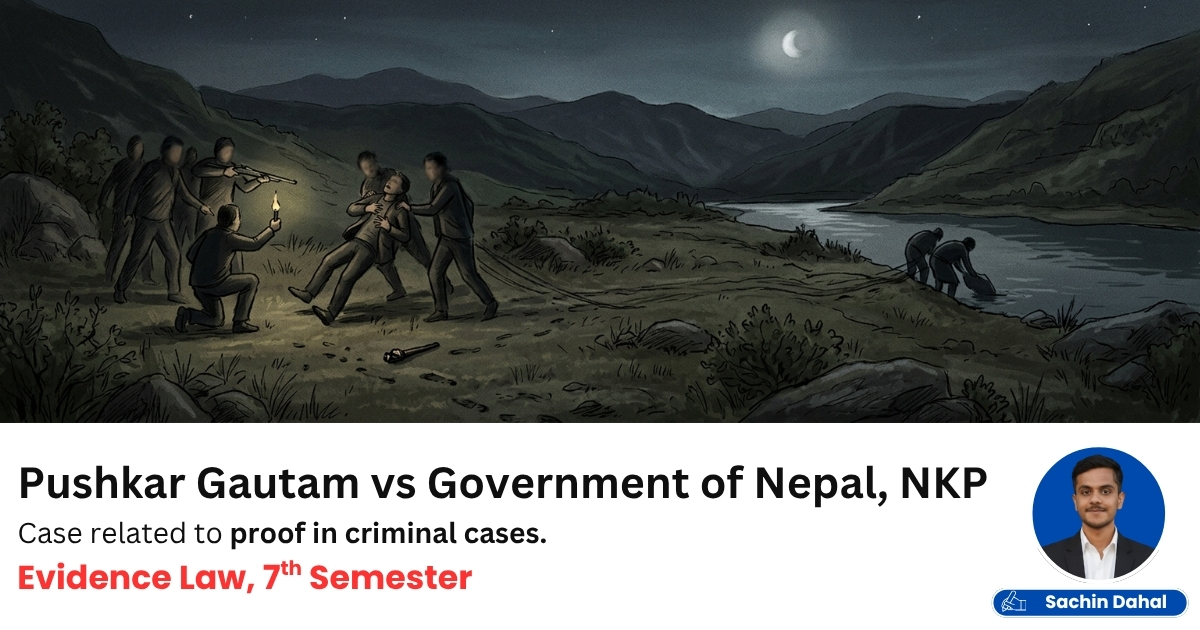
Bhuwan Kumar (also known as Ujjan Kumar) Shrestha was travelling to Dhobi Haat early in the morning to purchase goods for his shop. While passing through Khahare Dobhan, he was assaulted by several accused persons. Pushkar Gautam flashed a torch at the victim, allowing Balkrishna Dhungel to shoot him. The accused then dragged the injured victim through the fields to the Likhu River and threw him into the river. His body was never recovered.
The victim’s brother filed a complaint alleging that the murder had been planned in advance by several accused persons. During the investigation, eyewitnesses stated that they had seen Pushkar Gautam flashing the torch, Balkrishna Dhungel firing the shot, and other accused dragging the victim towards the river. The investigation also found bloodstains, footprints, drag marks, and the victim’s torch near the river, which supported the eyewitness accounts.
Pushkar Gautam was accused of facilitating the murder by making the victim visible to the shooter. Keshavhari Dhungel was also prosecuted for his alleged involvement in the offence. However, while there was direct and circumstantial evidence against Pushkar Gautam, the evidence against Keshavhari Dhungel was mainly based on suspicion.
Legal Issues:
1. Whether eyewitness and circumstantial evidence were sufficient to convict Pushkar Gautam.
2. Whether an accused can be convicted when the victim’s body is not recovered.
3. Whether Keshavhari Dhungel’s guilt was proved beyond reasonable doubt.
4. Whether suspicion or the conviction of co-accused is sufficient to establish guilt.
Decision of the Courts:
Okaldhunga District Court:
The District Court convicted Pushkar Gautam and sentenced him to life imprisonment. It acquitted Keshavhari Dhungel due to insufficient evidence.
Rajbiraj Appellate Court:
The Appellate Court upheld the District Court’s decision. It confirmed Pushkar Gautam’s conviction and life imprisonment and also upheld the acquittal of Keshavhari Dhungel.
Supreme Court:
The Supreme Court upheld the conviction of Pushkar Gautam. It held that the consistent eyewitness testimony, supported by the surrounding circumstances and other evidence, proved beyond reasonable doubt that he had assisted the murder by flashing the torch. The Court further held that the non-recovery of the victim’s body did not prevent a conviction where the remaining evidence was sufficient to establish the offence.
However, the Court upheld the acquittal of Keshavhari Dhungel. It found that there was no independent and reliable evidence proving his involvement in the offence. The Court held that mere suspicion, however strong, could not replace proof beyond reasonable doubt. It also emphasized that the conviction of one co-accused does not automatically establish the guilt of another accused. Each accused must be convicted on the basis of evidence proving his own involvement.
Principle Established:
• The burden of proving guilt lies on the prosecution.
• An accused can be convicted without recovery of the dead body if reliable evidence proves the offence.
• Strong suspicion cannot replace proof beyond reasonable doubt.
• Every accused must be judged individually, and the conviction of one co-accused does not automatically establish the guilt of another.
• The benefit of doubt must be given to the accused where the prosecution fails to prove guilt beyond reasonable doubt.