

Evidence Law Case: Ram Shahi v. Prem Kumari Shahi NKP 2079 B.S., Vol.4, DN: 10854
Case: Partition of Property
Plaintiff: Prem Kumari Shahi et.al
Defendant: Ram Shahi et.al
Decision Number: 10854
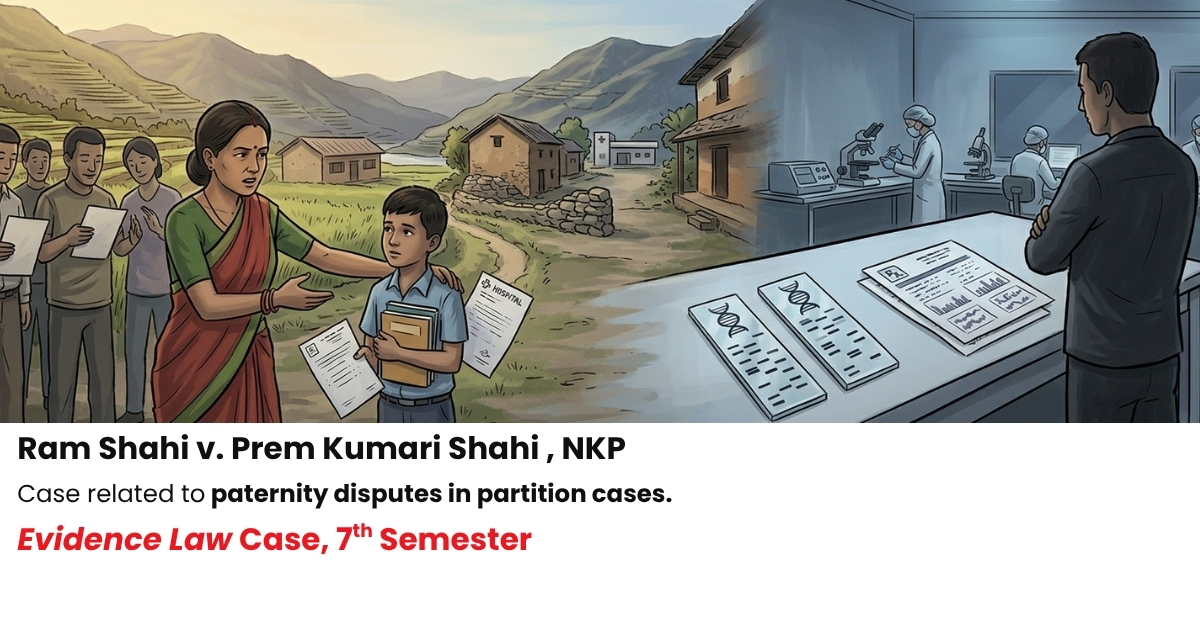
This case is related to paternity disputes in partition (Ansha) cases, the evidentiary value of DNA and documentary evidence, the burden of proving separate property, and the principle that paternity must be determined by evaluating all relevant evidence rather than relying solely on DNA test results.
Facts of the case:
Prem Kumari Shahi claimed that she was the second wife of Ram Shahi and that they had a son, Binod Shahi. She alleged that Ram Shahi’s property had never been partitioned among the family members and sought recognition of their relationship along with their share in the ancestral property.
Ram Shahi denied marrying Prem Kumari or being Binod’s father. He argued that there was no official proof of the marriage and pointed out that Prem Kumari had not listed him as her husband in her citizenship certificate. He claimed that the case was filed only to obtain a share of his property.
To determine the disputed paternity, DNA tests were conducted twice by the National Forensic Science Laboratory. Both reports concluded that Ram Shahi was not Binod’s biological father. Despite these findings, Prem Kumari relied on witness testimony and documentary evidence, including school and hospital records, to support her claim that she and Binod were Ram Shahi’s lawful wife and son.
The dispute therefore centered on whether the DNA reports should prevail over the oral and documentary evidence presented by Prem Kumari in determining the existence of the marital relationship, Binod’s paternity, and their entitlement to a share in the family property.
Legal Issues:
1. Whether a DNA test is conclusive evidence for determining paternity.
2. Whether documentary and circumstantial evidence can prevail over a negative DNA test in proving family relationships.
3. Whether failure to mention a husband’s name in a citizenship certificate disproves the existence of a marriage.
4. Whether legal heirs can continue a pending partition claim and whether disputed property forms part of the joint family property.
Decisions of the Courts:
Kathmandu District Court:
The District Court dismissed the suit, holding that Premkumari failed to prove her marriage with Ram Shahi. Relying primarily on the negative DNA test and the absence of Ram Shahi’s name in her citizenship certificate, the Court denied the plaintiffs any share in the property.
Patan Appeal Court:
The Appeal Court reversed the District Court’s decision. By majority, it recognized Premkumari and Vinod as the lawful wife and son of Ram Shahi and awarded them 2/5 shares of the family property, holding that the evidence as a whole established their relationship.
Supreme Court Decision:
The Supreme Court upheld the Appeal Court’s judgment and dismissed Ram Shahi’s appeal. It held that although DNA testing is an important scientific method, it is not conclusive evidence of paternity and must be evaluated together with other relevant evidence.
The Court found that the hospital records, municipal documents, school records, and Vinod’s earlier sworn statements consistently identified Ram Shahi as his father. It also held that a mother’s statement regarding the identity of her child’s father carries significant evidentiary value. Further, the Court ruled that the omission of a husband’s name in a citizenship certificate does not disprove a marriage, as Nepali law permits a person to mention either the father’s or the husband’s name.
During the proceedings, Vinod’s widow and son were allowed to continue the case as his legal heirs. The Court also held that Ram Shahi failed to prove that the property gifted to his first wife was her exclusive property. As a result, it was treated as joint family property and included in the partition. Accordingly, Premkumari Shahi and Vinod Shahi (through his legal heirs) were awarded 2 out of 5 shares of the property.
Principle Established:
• DNA evidence is an important but not conclusive proof of paternity.
• Documentary evidence and prior admissions may establish family relationships despite a negative DNA test.
• Failure to mention a husband’s name in a citizenship certificate does not disprove marriage.
• Legal heirs may continue a pending partition suit, and the burden of proving separate property lies on the person asserting it.