

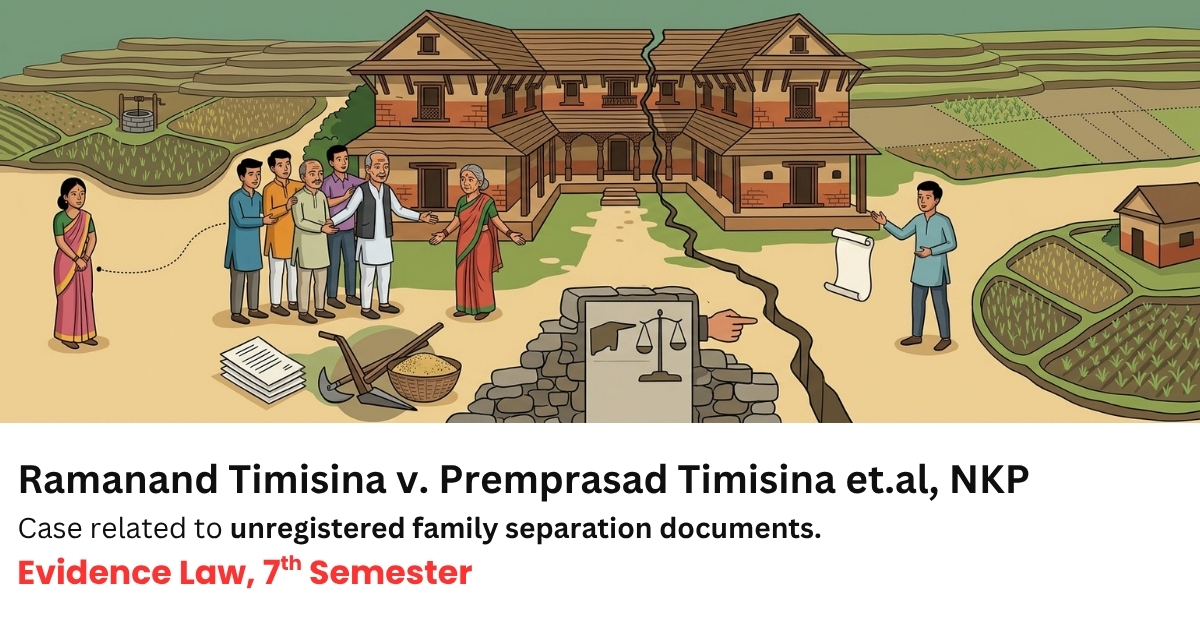
Evidence Law Case: Ramanand Timisina v. Premprasad Timisina et.al, NKP 2075 B.S.,Vol.6, DN: 10035
Case: Partition of Property
Plaintiff: Ramanand Timisina
Defendant: Premprasad Timisina et.al.
Decision Number: 10035
This case is related to the evidentiary value of unregistered family separation documents, the burden of proving self-acquired property in partition disputes, the legal status of property blended into joint family property, and the principles governing gift deeds and joint family property in partition cases.
Facts of the Case:
Dilliprasad Timsina and his wife Mainadevi Timsina had five sons and one married daughter. The family lived jointly for many years, and besides their ancestral property, they purchased additional land and built houses using income generated from the joint family property. Although many of these properties were registered in the names of different family members, they continued to be possessed and used as family property.
Ramanand Timsina filed a partition (Ansha Darta) case claiming that despite being a coparcener, he was denied his lawful share in the family property. He sought partition of all joint family assets, claiming that the family had never legally separated and that all the disputed properties were jointly acquired.
The other defendants opposed the claim, arguing that the family had already separated through an informal household arrangement (ghar-sarma) many years earlier. According to them, any property acquired after that separation was purchased from their own independent earnings and therefore could not be included in the partition. They also claimed that certain lands received through gift deeds were the personal property of the recipients.
During the proceedings, the father, Dilliprasad, denied the validity of some documents relied upon by the defendants and claimed that his signatures on those documents had been obtained on blank papers.
Legal Issues:
1. Whether an unregistered household separation agreement is sufficient to establish legal separation for partition purposes.
2. Whether the disputed properties were joint family property or the personal property of the defendants.
3. Whether property transferred through gift deeds between family members is exempt from partition.
4. Whether the disputed documents relied upon by the defendants were forged.
Decision of the Courts:
Udayapur District Court:
The District Court held that the alleged household separation was not legally proved. It found the disputed documents to be forged and ruled that the disputed properties were joint family property. Accordingly, it ordered the property to be partitioned into seven equal shares among the heirs.
Rajbiraj Appeal Court:
The Appeal Court reversed the District Court’s finding that the disputed documents were forged, holding that forgery had not been proved due to insufficient evidence. However, it agreed that the family had not legally separated and upheld the order to partition the joint family property into seven equal shares.
Supreme Court:
The Supreme Court upheld the Appeal Court’s decision. It held that an unregistered household separation agreement was insufficient to establish legal family separation. Since the defendants failed to prove that the disputed properties had been acquired from their independent earnings, the properties were presumed to be joint family property. The Court further held that property transferred through gift deeds between family members could still be treated as joint family property if it originated from the joint family estate.
It also agreed that the allegation of forgery had not been proved due to insufficient evidence. Accordingly, the Court upheld the partition of the joint family property into seven equal shares and dismissed all appeals.
Principle established:
• An unregistered household separation agreement is not sufficient to legally prove family separation.
• Property is presumed to be joint family property unless a party proves that it was acquired through his or her independent earnings.
• The burden of proof lies on the person claiming self-acquired property to establish independent ownership.
• Property transferred through gift deeds between family members may still be treated as joint family property if it originated from the joint family estate.
• Allegations of forgery must be proved with sufficient evidence.
Disclaimer:
The case name provided in the syllabus, Government of Nepal v. Padam Bahadur Gurung, appears to be incorrect. The case could not be found in the Nepal Kanoon Patrika under the prescribed decision number or through any other available legal source. Therefore, this case brief has been prepared based on the case corresponding to the decision number provided in the syllabus.