
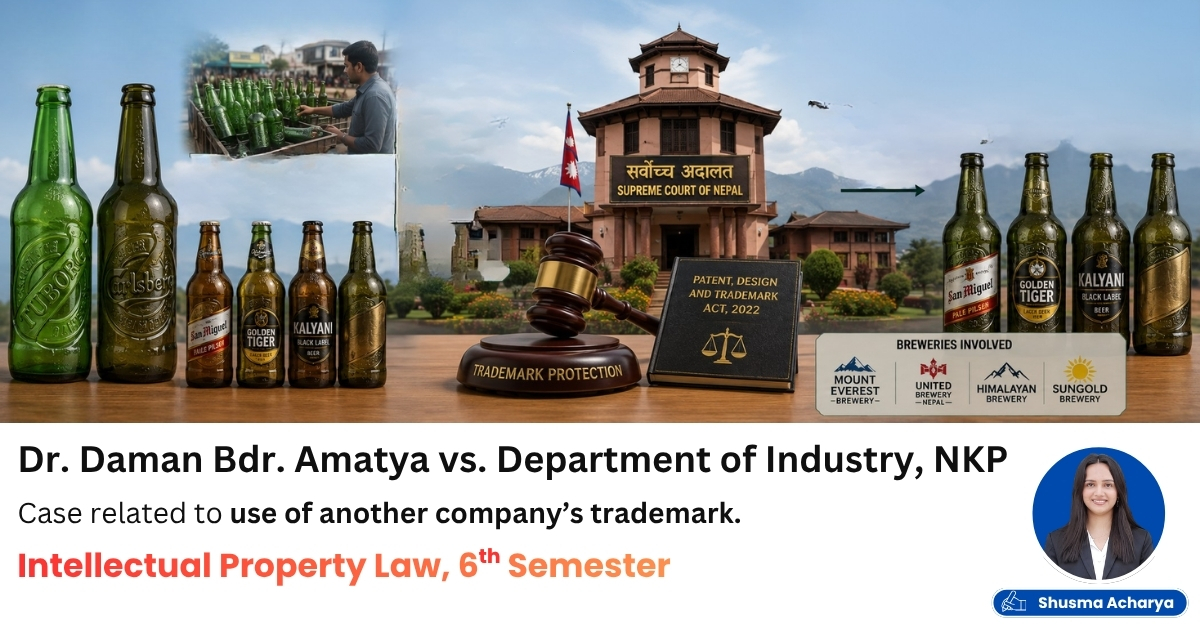
Intellectual Property Case: Dr. Daman Bdr. Amatya vs. Department of Industry, NKP 2067 B.S, Number 4, p. 650, DN 8356
Case: Illegal Use of Empty Bottles Bearing Trademark
Plaintiff/Applicant: Mount Everest Brewery Pvt. Ltd. represented by Dr. Daman Bahadur Amatya & United Brewery Nepal Pvt. Ltd. represented by Premdhwoj Thapa
Defendant/Respondent: Department of Industry
Decision Number: 8356
This case is related to Trademark law specifically whether an empty bottle bearing another company’s embossed trademark can be lawfully reused by a competing manufacturers.
Facts of the Case:
Gorkha Brewery Pvt. Ltd. produced “Tuborg” and “Carlsberg” brand beer in bottles embossed with its registered trademark (“Tuborg” wording and logo). After consumers purchased and emptied these bottles, the empty bottles entered the open market and were purchased by other brewery companies – Mount Everest Brewery, United Brewery Nepal, Himalayan Brewery, and Sungold Brewery – who refilled them with their own beer products (San Miguel, Golden Tiger, Kalyani Black Label, etc.) and sold them to consumers. Gorkha Brewery complained to the Department of Industry that this practice damaged its brand identity and requested that other companies be stopped from using bottles embossed with its trademark.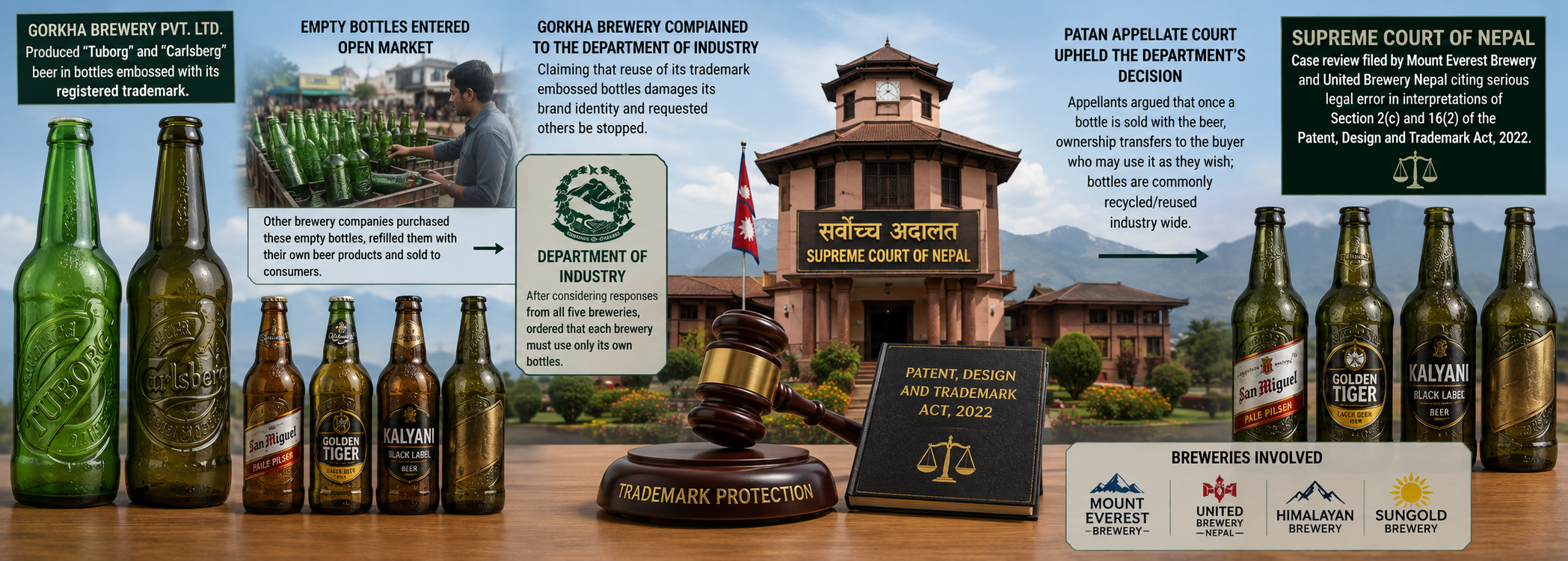
Department of Industry, after seeking responses from the five breweries, decided that each brewery must use only its own bottles. Mount Everest Brewery and United Brewery Nepal appealed this decision to the Patan Appellate Court, arguing that once a bottle is sold with the beer, physical ownership of the bottle transfers to the buyer, who may use it as they wish; bottles are commonly recycled/reused industry wide.
Patan Appellate Court upheld the Department’s decision. The appellants then filed for case review before the Supreme Court arguing serious legal error in interpretations of Section 2(c) and 16(2) of the Patent, Design and Trademark Act, 2022.
Legal Issues:
- Whether a bottle used to pack beer or other liquid is, by itself, an item registrable as a “trademark” under the Act?
- Whether the owner of a registered trademark embossed on a bottle/wrapper must itself manufacture the bottle to regain rights over that trademark?
- Whether the owner (or lawful user) of a trademark has the right to stop competing industries from using bottles embossed with that trademark, and what is the scope of such right?
Different Courts Decision:
Department of Industry:
The Department of Industry directed all five beer companies to use only their own respective bottles; ordered the practice of using competitor’s embossed bottles to stop.
Patan Appellate Court:
Appellate Court upheld the decision of the Department of Industry.
Supreme Court:
The Joint Bench of Justices Bharat Raj Upreti and Prem Sharma upheld both lower decisions and dismissed the appeal. An empty bottle, by itself is not a “word, sign or picture” and therefore cannot itself constitute a trademark under Section 2(c) of the Act; at most, the bottle’s shape/design may be registrable as an industrial “design” under the Patent, Design and Trademark Act, 2022.
Where a word, sign, picture, or logo is embossed on the bottle to distinguish the product of one producer from another, that embossed mark does constitute a trademark, and it need not be manufactured by the trademark owner itself – outsourcing bottle/wrapper production to a separate manufacturer is standard commercial practice.
A producer holds two distinct types of ownership rights in a manufactured good: (a) physical/proprietary ownership of the item itself, and (b) intellectual/industrial property rights in the trademark or design used to distinguish it from competitors’ goods. When a consumer buys a bottled beverage, physical ownership transfers to the buyer but ownership of the embossed trademark does not transfer – it remains with the trademark owner. Therefore, a buyer of an empty branded bottle cannot lawfully use it to pack a competing product in a manner that infringes the trademark owner’s rights or misleads consumers as per Section 16(2) of the Patent, Design and Trademark Act, 2022.
Principle Established:
- An empty bottle, container, or receptacle is not, by itself, a “trademark” under trademark law – it may at most qualify for design registration.
- A word, sign, picture, or logo embossed/printed on a bottle or wrapper to distinguish one producer’s goods from another’s is a trademark, regardless of whether the trademark owner itself manufactures the bottle/wrapper.
- Sale of a product transfers physical ownership of its container to the buyer but does not transfer the seller’s intellectual property rights.
- A buyer of an empty trademark embossed bottle may dispose of, destroy, or repurpose the bottle materially, but may not reuse the trademark itself to pack a similar product in a way that could mislead consumers or harm the trademark owner’s interests.
- Unauthorized use of another’s registered trademark by a competitor is presumed to cause consumer confusion; the “benefit of the doubt” on this question belongs to the trademark owner, not the competitor.
Relevancy of the Case:
This case clarifies that the sale of goods does not exhaust or transfer the seller’s trademark rights embedded in reusable containers.