

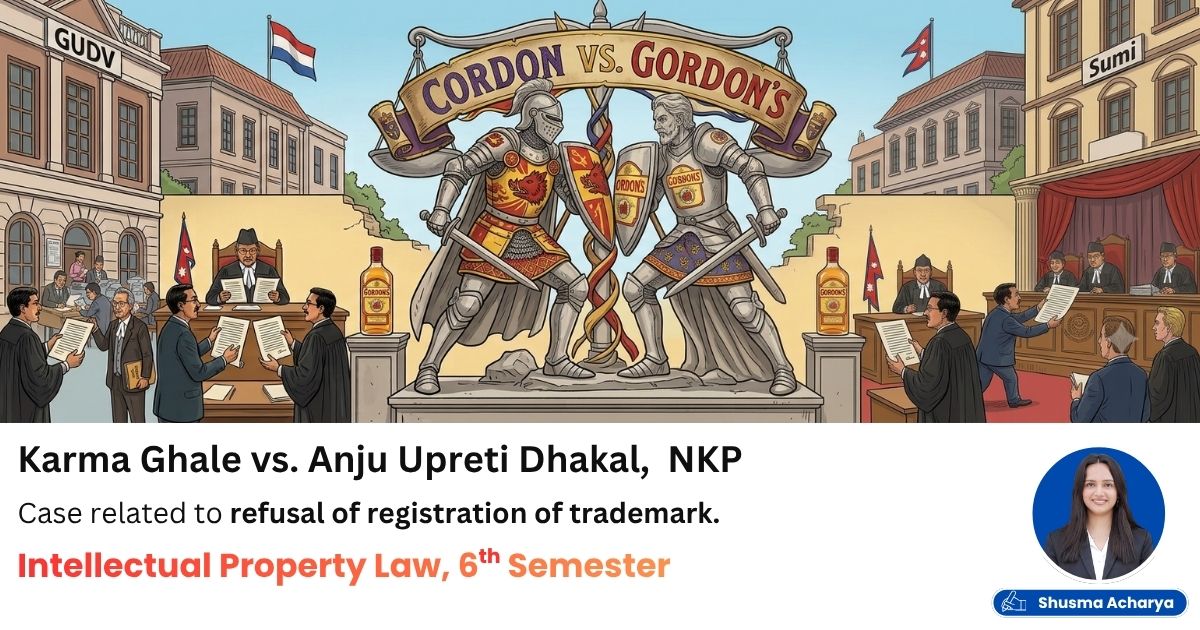
Intellectual Property Case: Karma Ghale vs. Anju Upreti Dhakal, NKP 2068 B.S, Number 3, p.448, DN 8577.
Case: Trademark Registration
Plaintiff/Applicant: Guinness United Distillers & Vintners Amsterdam B.V., represented through its authorized representative Anju Upreti Dhakal
Defendant/Respondent: Sumi Distillery Pvt. Ltd., represented by its authorized representative Karma Ghale
Decision Number: 8577
This case is related to refusal of registration of trademark under the Patent, Design and Trademark Act, 2022.
Facts of the Case:
Sumi Distillery Pvt. Ltd. (a Nepali company) had already registered the trademark “CORDON” in Nepal and was using it on its products. A Dutch company, Guinness United Distillers & Vintners Amsterdam B.V., wanted to register its own trademark, “GORDON’S” in Nepal for use on liquor products.
On 2060/09/14, Dutch company’s representative (Lawyers & Lawyers Pvt. Ltd.) applied to the Department of Industry to register “GORDON’S.” The Department informed them that this could not be done because “CORDON” was already registered. The company did not appeal this decision. The Dutch company changed its local representative to Pioneer Law Associates. On 2061/08/23, the Department of Industry again rejected the application. Its reasoning: “GORDON’S” looked and sounded too similar to the already registered “CORDON”, and allowing both to exist would confuse ordinary consumers. This decision was based on the opinion given by the Department’s legal officer. The Dutch company then appealed this rejection to the Patan Appellate Court.
While this appeal was pending, Dutch company also filed a different complaint asking the Department to cancel Sumi Distillery’s “CORDON” registration. The Department had put this cancellation complaint on hold stating it would decide it only after the registration case was finished.
Patan Appellate Court ruled that these two matters – (a) the application to register “GORDON’S” and (b) the complaint to cancel “CORDON” were connected and should be decided together and not separately. It cancelled the Department’s decision and sent the case back to the Department of Industry, instructing it to gather any further evidence needed and decide both matters at once. Sumi Distillery, who was not satisfied with this outcome, appealed to the Supreme Court.
Legal Issues:
- Is the Department of Industry’s decision rejecting registration of “GORDON’S” based on similarity with the already registered “CORDON” mark, legally correct?
- Whether it was proper for the Patan Appellate Court to direct that the pending cancellation complaint against “CORDON” and the fresh registration application for “GORDON’S” be examined and decided together?
- Whether Nepal’s obligations under international treaties (Paris Convention, TRIPS Agreement, Treaty Act, 2047) regarding protection of well known trademarks and industrial property must inform the interpretation of the Patent, Design and Trademark Act, 2022?
- Whether the State has a public duty to protect intellectual property to safeguard the rights holder and to prevent consumer confusion?
Different Courts Decision:
Department of Industry:
The Department rejected the application to register “GORDON’S” holding it is phonetically/visually similar to the already registered “CORDON’ relying on the legal officer’s opinion.
Patan Appellate Court:
The Appellate Court set aside the Department’s decision and remanded the matter, directing that the pending cancellation complaint against “CORDON” and the registration application for “GORDON’S” be reviewed and decided together, after gathering all necessary evidence.
Supreme Court:
Supreme Court upheld the decision of the Patan Appellate Court. The Court did not directly order that GORDON’S must be registered, or CORDON must be cancelled but it held that protection of industrial property is a matter of public duty for the State, both to preserve the exclusive rights of an industry/right holder and to protect consumers from confusion. Nepal, having ratified the Paris Convention and being a member of the WTO/TRIPS regime, is bound under the Treaty Act, 2047 to ensure domestic law is compatible with these international commitments; where domestic law conflicts with treaty provisions, the treaty prevails.
Under Section 18(3) of the Patent, Design and Trademark Act, 2022, the Department of Industry has authority to cancel a registered trademark at any time if it is found to damage the goodwill/reputation of another trademark. Since the outcome of the cancellation complaint against “CORDON” would directly affect whether “GORDON’S” could be registered, it was appropriate not erroneous for the Appellate Court to direct that both matters be examined jointly.
The appeal filed by the defendant Sumi Distillery was found not to succeed; the Department of Industry’s 2061/08/23 decision was rightly set aside, and the matter was to be reconsidered on merits, considering both pending applications together.
Principle Established:
- Protection of Patents, Designs and Trademarks (industrial property) is a fundamental public duty of the state both to protect the innovator’s exclusive rights and to protect consumers from confusion caused by similar/deceptive marks.
- Where two related matters an application for cancellation of an existing mark and an application for registration of a similar new mark are pending simultaneously and their outcomes are interdependent, they should be examined and decided together rather than separately.
- Nepal’s domestic trademark law must be interpreted in harmony with its international treaty obligations; where conflict exists between domestic law and treaty provisions, treaty provisions prevail.
Relevancy of the Case:
This case is significant as it articulates the State’s public duty to trademarks and industrial property rights.