

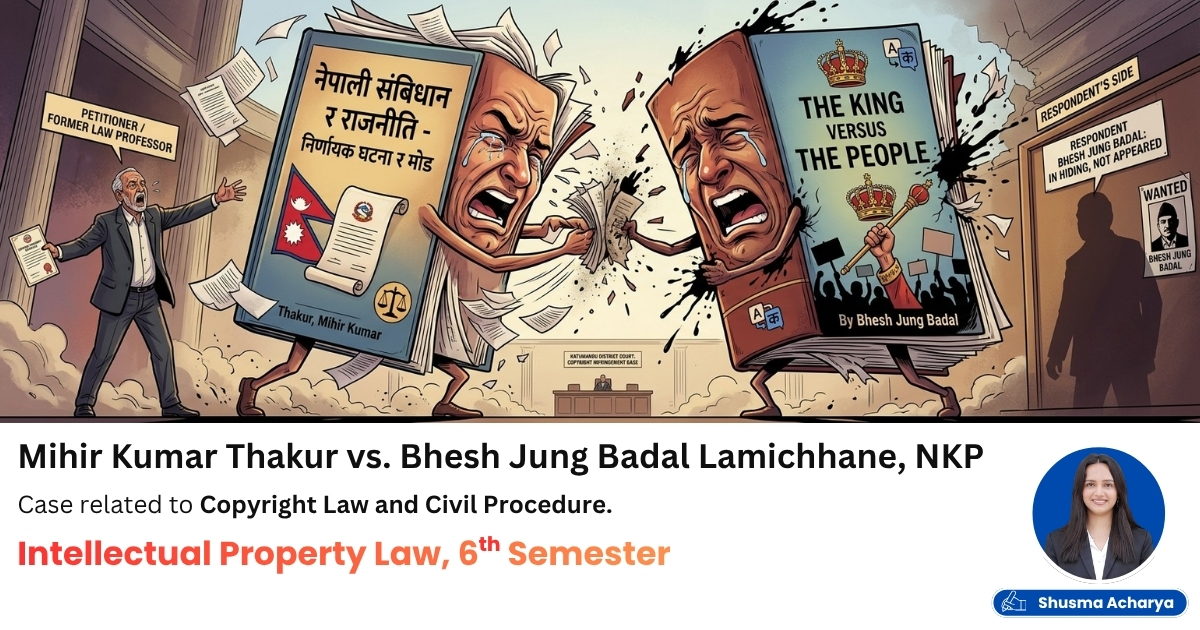
Intellectual Property Case: Mihir Kumar Thakur vs. Bhesh Jung Badal Lamichhane, NKP 2066 B.S, Number 12, p. 2017, DN 8283
Case: Writ Petition regarding validity of service of summons
Plaintiff/Applicant: Mihir Kumar Thakur
Defendant/Respondent: Bhesh Jung Badal Lamichhane
Decision Number: 8283
This case is related to Copyright Law and Civil Procedure.
Facts of the Case:
The petitioner, a former law professor, authored a Nepali book titled “Nepali Sambidhan ra Rajniti – Nirnayak Ghatana ra Mod”, for which he held registered copyright. He filed a complaint alleging that the respondent, Bhesh Jung Badal, published an unauthorized English translation titled “The King Versus The People”, infringing his copyright. A copyright infringement case was filed at Kathmandu District Court. The respondent went into hiding and never showed up for this case.
While avoiding the copyright case, the respondent turned around and filed a separate defamation case against the petitioner over a newspaper article about the copyright dispute. Oddly, he showed up and actively fought this case, even though it was heard together with the case he was “avoiding.” The District Court decided both cases and the respondent was found guilty of copyright infringement and ordered to pay compensation and his defamation claim against the petitioner failed. Nobody appealed, so this decision became final.
When the petitioner tried to enforce the judgement and collect compensation, the respondent suddenly claimed – nearly seven months later – that he had never been properly notified of the original copyright case, and asked the court to cancel that notice and let him restart his defense. The District Court rejected this saying that the notice had been properly served. The respondent then appealed to the Patan Appellate Court which reopened the case and later the petitioner approached the Supreme Court arguing this reopening was not legally justified.
Legal Issues:
- Whether the Patan Appellate Court’s order declaring the summons served on the respondent was lawful.
- Whether the writ of certiorari (and mandamus) sought by the petitioner should be issued.
- Whether a defendant who had actual knowledge of the case can still claim the benefit.
Different Courts Decision:
Kathmandu District Court:
District Court held the service of summons was proper and rejected the respondent’s application.
Patan Appellate Court:
Appellate Court annulled the summons as defective – based on a ward committee’s recommendation that the witnesses were not actual residents of the ward – and ordered the District Court to proceed lawfully.
Supreme Court:
Supreme Court held that the Appellate Court erred by relying on material outside the case record and outside the scope of what was before the trial court when the original order was made. It found that the respondent had actual knowledge of the copyright case which is evidenced by his simultaneous, active pursuit of a related defamation case concerning the very same subject matter.
The Court concluded that the respondent’s claim was made in bad faith to delay execution of a final judgement.
The Court issued an order of certiorari quashing the Patan Appellate Court’s order and all consequent proceedings. The Court also issued a writ of mandamus directing Kathmandu District Court to proceed with enforcement of its judgment.
Principle Established:
- When determining whether service of summons was proper or defective under No. 17 of the Court Proceedings, the Appellate Court must confine itself to material that was part of the original case record and it cannot rely on recommendations or facts introduced only after the petition was filed.
- The duty of a notice-issuing authority is to make an honest, good-faith effort to communicate notice to the concerned person; the doctrine of notice cannot be used to satisfy a party who denies receiving notice or feigns ignorance despite having received it. Otherwise, service of summons becomes a mere ritualistic, mechanical formality.
- A party who had knowledge of a case cannot later claim ignorance to invoke the relief.