
Interpretation of Law Case: Parshuram Banjade, on behalf of Yagyamurti Banjade vs. Durga Das Shrestha, Bagmati Special Court, & Others, NKP 2027 B.S, Vol: 7, DN: 547.
Case: Writ of Habeas Corpus
Petitioner: Parshuram Banjade, on behalf of Yagyamurti Banjade
Respondents: Durgadas Shrestha, Bagmati Special Court, & Others
Decision Number: 547
This case is related to statutory interpretation regarding legislative amendments, the scope of executive authority, principle of natural justice, the fundamental rights to legal representation and personal liberty.
Facts of the Case:
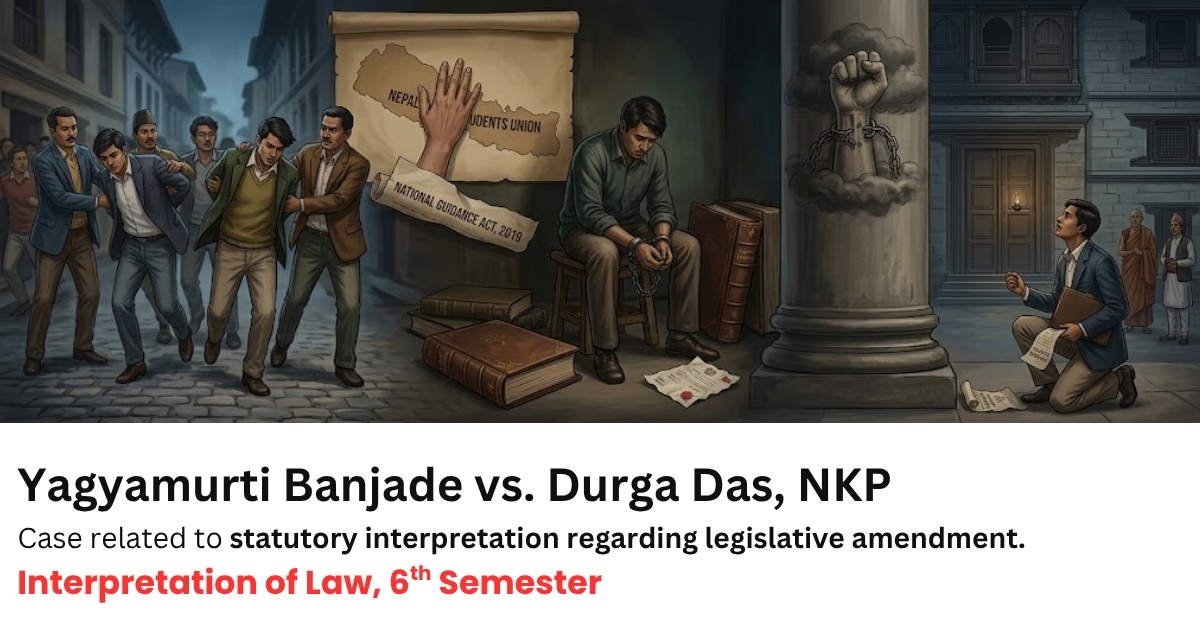
On 18th Baisakh 2027 B.S., Yagyamurti Banjade and several other students were arrested at Naya Sadak, Kathmandu, by state security personnel dressed in civilian clothes. The arresting officers did not present an arrest warrant nor did they disclose the legal grounds for the arrest. Following this, the individuals were taken directly into custody and incarcerated at the Central Jail (Kendriya Karagar) of Kathmandu.
The administration justified the detention by alleging that the students had formed an unauthorized organization, the “Nepal Students Union”, without government approval, which they claimed violated the National Guidance Act, 2019 B.S. However, a legislative amendment passed in 2024 B.S. had already explicitly removed the phrase “student union” from the statute’s prohibited list. Despite this legal reality, His Majesty’s Government published an official notification in the Nepal Gazette on 21st Baisakh 2027 B.S., delegating special judicial authority to Durga Das Shrestha, the Chairman of the Bagmati Special Court.
On 29th Jestha 2027 B.S., the detainee was subjected to a late-evening, closed-door summary proceeding without public access or the opportunity to consult or be represented by a legal practitioner of his choice.
Asserting that his brother was being subjected to illegal confinement without statutory backing and in clear violation of his constitutional rights, Parshuram Banjade filed a writ petition of Habeas Corpus directly before the Supreme Court of Nepal demanding Yagyamurti Banjade’s immediate release.
Legal Issues:
- Whether the removal of the phrase “student union” through a legislative amendment meant the activity was no longer prohibited under the National Direction Act.
- Whether an administrative officer exercising quasi-judicial powers is mandated to apply a judicial mind and adhere to the principles of natural justice.
- Whether conducting summary proceedings without informing the accused of their right to legal counsel violates the constitutional guarantee under Article 11(6) of the Constitution of Nepal.
- Whether the executive or a quasi-judicial body can curtail personal liberty without strict and literal compliance with both substantive and procedural laws.
Decisions of the Courts:
Bagmati Special Court:
His Majesty’s Government delegated special quasi-judicial authority to Durga Das Shrestha, Chairman of the Bagmati Special Court, to act as the trial court for this matter. On 29th Jestha 2027 B.S., he conducted a hurried, closed-door interrogation of the detainees near Singha Durbar Putali Garden, without allowing them access to legal practitioners/lawyers.
The Special Court ruled that forming the “Nepal Students Union” was an offense and issued a judicial order convicting the detainee and imposing a punishment of imprisonment and a fine, citing Section 53 of the Chapter on Punishment.
Supreme Court:
The Division Bench of the Supreme Court quashed the order issued by Durga Das Shrestha of the Bagmati Special Court and issued a writ of Habeas Corpus, ordering the immediate release of the detainee. The Court held that because the legislature had deliberately omitted “student union” from the National Guidance Act, the detainee’s actions did not constitute a statutory offense.
The Court further ruled that the trial conducted in closed doors without allowing legal representation was unconstitutional and void due to non-compliance with procedural and substantive law.
Principles Established:
- When the legislature amends an Act and intentionally removes a specific word or phrase, courts must interpret that omission as a clear legislative intent to remove that subject matter entirely from the prohibition or scope of the statute.
- In a democratic system where personal freedom is paramount, if an act is not explicitly forbidden by law, it must be interpreted as legally permissible.
- Administrative officials tasked with making judicial determinations perform quasi-judicial functions and must maintain an impartial, judicial standpoint.
- The constitutional right to consult and be defended by a legal practitioner is absolute; authorities cannot bypass this right by claiming the detainee did not proactively demand a lawyer.
- Any substantive or procedural law that empowers the state to deprive an individual of life or personal liberty must be interpreted strictly and adhered to letter by letter.