

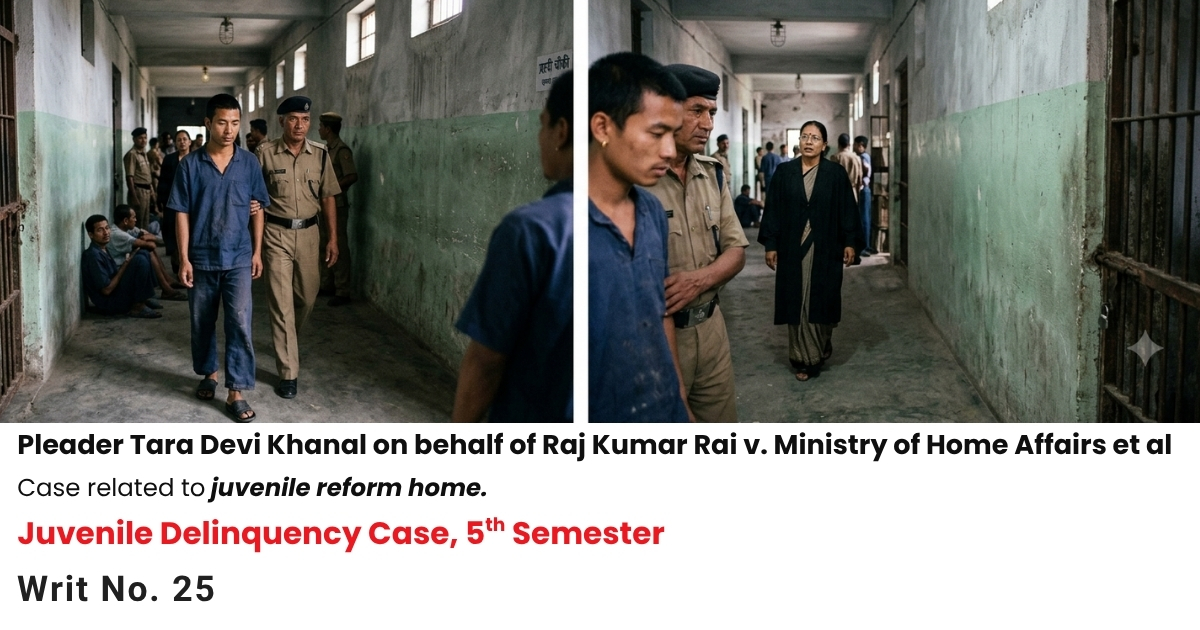
Juvenile Delinquency Case: Pleader Tara Devi Khanal on behalf of Raj Kumar Rai v. Ministry of Home Affairs et al, Writ no 25 of the year 2058, Date of Decision: 2058/10/02 BS
Case: Habeas Corpus writ petition regarding juvenile justice
Plaintiff: Pleader Tara Devi Khanal on behalf of Raj Kumar Rai
Respondent: Ministry of Home Affairs et al
Writ Number: 25 of the year 2058
This case is related to juvenile reform homes.
Facts of the Case:
Raj Kumar Rai was a 12 year old child originally from Namobuddha Village Development Committee, Kavrepalanchowk, living in a rented house in Kathmandu. A charge sheet was filed against him before the Kathmandu District Court on July 30, 2001.
On Shrawan 16 2058, the Kathmandu District Court issued a detention order under Number 118 of the Chapter on Court Management, ordering him to be sent to adult prison custody because he could not provide a required cash deposit/bail. A writ of habeas corpus was filed on his behalf by Pleader Tara Devi Khanal (representing the Free Legal Aid Programme for Prisoners conducted by CeLRRd), arguing that detaining a 12 year old child in an adult jail violated the explicit provisions of the Children’s Act, 2048 (1991).
Legal issues:
- Whether a child under the age of 16 can be lawfully detained in an adult prison or jail facility under standard adult criminal procedures (such as Number 118 of the Chapter on Court Management) for failing to deposit bail?
- Whether the court and prison authorities violated Section 15 and Section 42 of the Children’s Act, 2048 (1991), which guarantee alternative treatment, separate confinement, and placement in juvenile reform homes for minors?
Decision of the Courts:
Supreme Court:
The Supreme Court upheld the writ petition.
The Court observed that under Section 11(3) of the Children’s Act, a child of Raj Kumar’s age is only liable for a maximum of half the punishment awardable to an adult. By the time of the hearing, the child had already spent a highly disproportionate time in detention under adult jail conditions.
The Supreme Court ordered his immediate release from adult prison custody and mandated that any necessary institutional care or custody be arranged in a designated child reform home or under authorized guardianship, strictly following the Children’s Act.
Principles Established:
- Children under the age of 16 cannot be housed alongside adult inmates in standard jails, regardless of their financial inability to post bail.
- The specific protective provisions of the Children’s Act, 2048 override general procedural provisions when dealing with minors.
- The state must strictly bound judicial custody and sentences to the maximum statutory provisions provided for children.
Relevance of Case:
This case is a landmark precedent in Nepalese juvenile jurisprudence highlighting the insensitivity of the justice system at the bail hearing stage. It emphasizes that children in conflict with the law must be provided a reformative and rehabilitative environment rather than exposure to criminals in adult prisons which directly increases the vulnerability to recidivism.
Source: Baseline Survey on Juvenile Justice System In Nepal, 2010 {KSL JOURNAL}