

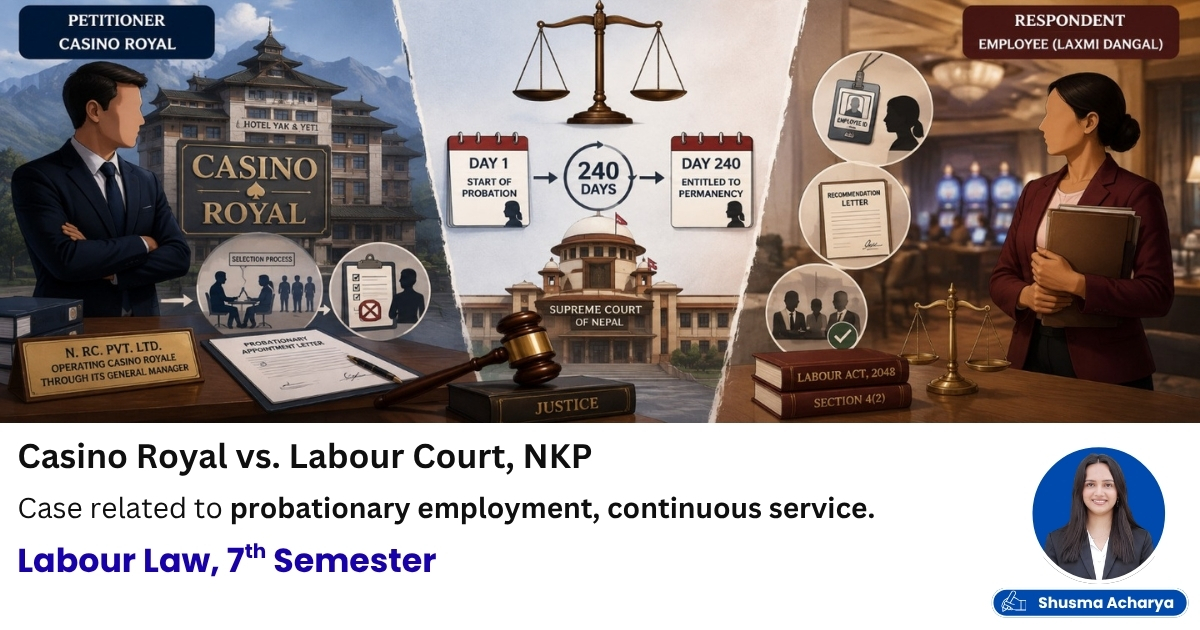
Labour Law Case: Casino Royal vs. Labour Court, NKP 2064 B.S, Vol. 5, P. 625, DN: 7849
Case: Certiorari and Mandamus
Plaintiff/Applicant: N. RC. Pvt. Ltd operating Casino Royale at Hotel Yak & Yeti through its General Manager T.R. Bhatt
Defendant/Respondent: Labour Court and others including employee Laxmi Dangal
Decision Number: 7849
This case is related to Labour Law specifically probationary employment, continuous service and permanency of appointment.
Facts of the Case:
The respondent, Laxmi Dangal, had been working as a Guest Relations Officer at Casino Royale since September 3, 2001, initially without a formal appointment letter and working on a “trainee” basis. On May 5, 2002, she was issued a probationary appointment letter effective from May 1, 2002, placing her on a 240 day probation period with a clause allowing the management to terminate her probationary employment without assigning any reason. During the probation period, her performance was evaluated, and based on a supervisor’s negative recommendation, the management terminated her probationary appointment through a letter dated December 27, 2002.
Dangal then appealed to the Labour Court arguing that her 240 day probation period had already been completed by December 26, 2022 and she was therefore entitled to permanent status before termination. The Labour Court ruled in her favour, holding that since she had worked beyond 240 days she was eligible for permanent appointment, and ordered her reinstatement, annulling the termination letter.
The petitioner company then filed writ petition before the Supreme Court challenging the Labour Court’s decision and arguing errors in the calculation of the 240 day period and in the interpretation of Section 4(2) of the Labour Act, 2048.
Legal Issues:
- What is the legal framework under the Labour Act for making appointments, and was the respondent’s appointment procedurally lawful?
- What is the legal concept and provision regarding probationary appointment, and can an employer remove an employee within the probationary period?
- Was the petitioner required to evaluate and decide on permanency within the probation period itself under Section 4 of the Labour Act, 2048 and had such evaluation been completed?
- Had the respondent completed 240 days of continuous service?
Different Courts Decision:
Labour Court:
The Labour Court held that the respondent Laxmi Dangal had worked more than 240 days and was therefore eligible for permanent appointment and annulled the termination letter issued against her and ordered her reinstatement.
Supreme Court:
Supreme Court upheld the decision of the Labour Court and dismissed the writ petition. The Court held that the petitioner had not strictly followed the recruitment procedure under Section 4(1) of the Labour Act which is the advertisement based selection procedure. Counting from May 1, 2002, the 240 day probation period was completed by December 26, 2002, so the termination letter issued on December 27, 2002 was issued after the probation period had lawfully ended.
Under Section 4(2) of the Labour Act, 2048 the employer is required to complete performance evaluation and decide on permanency within the probation period. This was not properly done and the evaluation was made by a supervisor rather than the appointing authority.
Separately, the Court also examined when she actually started working and not just what date was written on the letter. Evidence like ID card, admissions by the company itself and work record showed that she had been doing the same job since September 2001 even before she was given formal appointment letter under the “trainee” label. So under this alternative view, her real length of service was even longer and well passed the 240 day threshold.
Therefore, the termination was contrary to Section 4(2) of the Labour Act, 2048 and the Labour Court’s decision contained no legal error.
Principle Established:
- Labour Law must treat employer and employee equally while also empowering the employee with a degree of protection against unilateral control by the employer.
- Even though setting the probation period is a managerial prerogative, if the law itself prescribes specific conditions such as duration then the employer cannot exercise discretion beyond what the law permits as the statutory provision prevails.
- Employees cannot be kept working under a “trainee” designation without formal appointment except under the Industrial Trainee Act, 2039 where an employee continuously performs duties in a classified post beyond 240 days without lawful trainee status and the conditions of the Section 4(2) for permanency are deemed fulfilled.
Relevancy of the Case:
The decision of this case highlights Nepali Labour Jurisprudence on the strict statutory limits governing probationary employment particularly the 240 day probation period cannot be unilaterally extended by the employer and the evaluation and the permanency decision must be finalized within the probation period itself by proper appointing authority.