
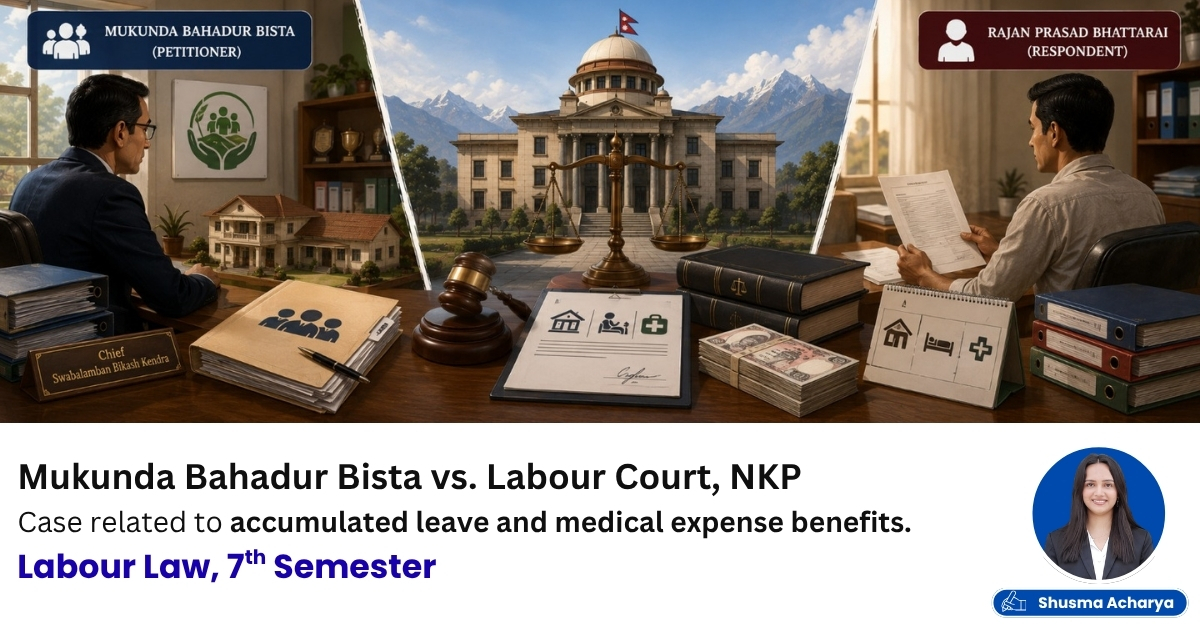
Labour Law Case: Mukunda Bahadur Bista vs. Labour Court, NKP 2063 B.S, DN: 7753, No. 8, P. 1099.
Case: Writ petition regarding entitlement to accumulated home leave, sick leave, and medical expense reimbursement
Plaintiff/Applicant: Mukunda Bahadur Bista, Chief of Swabalamban Bikash Kendra
Defendant/Respondent: Labour Court and others including Rajan Prasad Bhattarai
Decision Number: 7753
This case is related to applicability of Labour Act, 2048 and Labour Regulations, 2050 to employees and entitlement of accumulated leave and medical expense benefits upon separation from service.
Facts of the Case:
Rajan Prasad Bhattarai was appointed on 2055/04/12 B.S. as an employee of Swabalamban Bikash Kendra which is a social organization. He was removed from the service after being found to have obstructed the office’s work. Upon separation he received Rs 39, 951.72 in dues on 2059/01/25 B.S. He subsequently filed an application with the Labour Office claiming an additional Rs 15, 012.82 for accumulated home leave, sick leave, and medical treatment expenses. The Labour Office ruled in his favor, awarding Rs 13, 792.19. The Bikash Kendra appealed to the Labour Court which upheld the Labour Office’s decision.
The Bikash Kendra filed the writ petition before the Supreme Court under Articles 23 and 88(2) of the Constitution of the Kingdom of Nepal, 2047 seeking an order of certiorari to quash the decision of the Labour Court.
The petitioner argued that the Bikash Kendra being a social organization registered under the Society Registration Act, 2034 was not subject to the Labour Act and Regulations and that Bhattarai terms of service were governed by his contract.
Legal Issues:
- Whether the Labour Act, 2048 and Labour Regulations, 2050 apply to a social or non-governmental organization?
- Whether an organization falls within the definition of “प्रतिष्ठान” under Section 2(kha) of the Labour Act, 2048 merely by employing 10 or more workers/staff regardless of its social or non profit character?
- Whether an employee engaged under a contract which is silent on accumulated leave or medical benefits is entitled to statutory benefits under the Labour Regulations, or whether the contract exclusively governs the terms of service?
Different Courts Decision:
Labour Office:
Labour Office ruled in the favour of Rajan Prasad Bhattarai, ordering the Bikash Kendra to pay Rs 13,792.19 for accumulated leave and medical expenses.
Labour Court:
Labour Court upheld the Labour Office’s decision on appeal and rejected the Bikash Kendra’s contention that Labour Act/Regulations did not apply to it.
Supreme Court:
Supreme Court dismissed the writ petition holding that since the Bikash Kendra employed more than 10 workers or staffs it fell within the definition of “प्रतिष्ठान” under Section 2(kha) of the Labour Act, 2048 regardless of it being a social organization registered under the Society Registration Act, 2034. Unless a law or contract expressly and clearly excludes application of the Labour Act’s provisions to an organization, such exclusion cannot be presumed or inferred.
Labour Regulations, 2050 (Rules 30(2), 30(4), and 31(1)) clearly provide for payment of accumulated home leave and sick leave benefits to employees of an organization and since the contract between the parties did not expressly deny such benefits, the interpretation must favor the employee in the absence of a clear denial in law or contract.
Since Bhattarai’s contract had been renewed repeatedly and the Bikash Kendra employed more than 10 persons it fell within the statutory definition making the Labour Act and Regulations applicable to him despite his contractual appointment.
Principle Established:
- An intent to exclude application of the Labour Act’s provisions to employees of a particular organization must be expressly and clearly stated in law and such exclusion cannot be presumed merely from the social or non-profit character of the organization.
- Where the Labour Regulations expressly entitles employees or workers to payment for accumulated home leave and sick leave, and neither the law nor the contract expressly denies such payment, the benefit must be interpreted in the favour of the worker or employee.
- The character or objective of an organization does not by itself affect the service terms and benefits to which its employees or workers are entitled as workers.
Relevancy of the Case:
This decision is significant because it clarifies that NGOs and social organizations are not automatically exempt from the Labour Act, 2048 and Labour Regulations, 2050 simply because of their non-profit or social service character. It also establishes an important principle that ambiguity or silence in law or contract regarding employee benefits should be resolved in favor of the worker.