
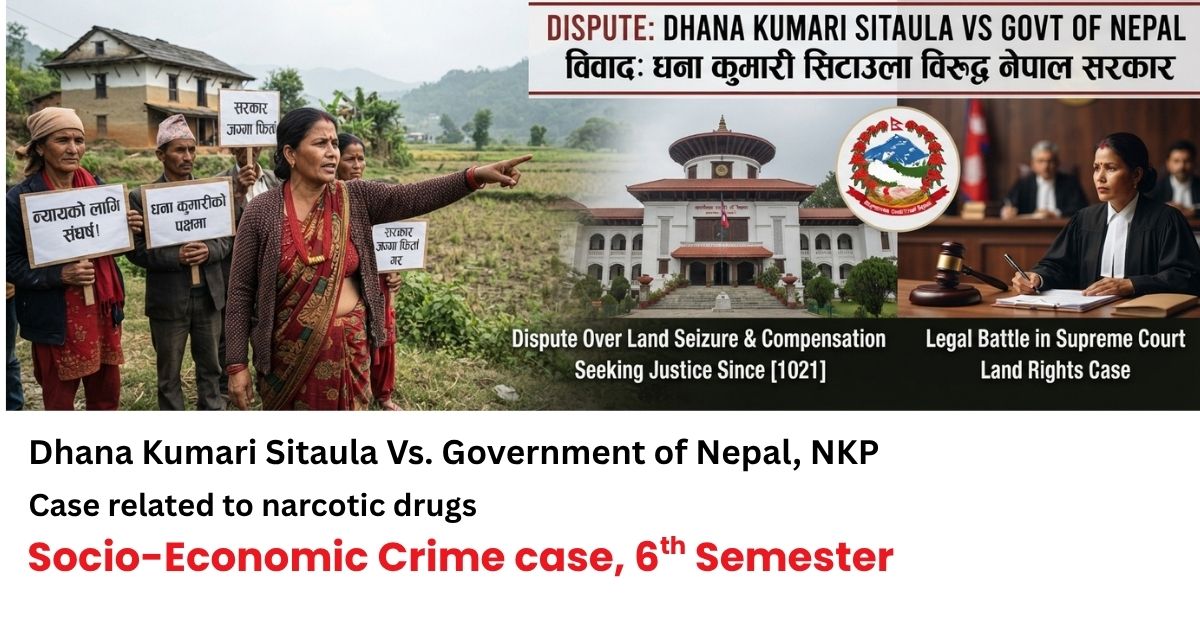
Socio-Economic Crime Case: Dhana Kumari Sitaula V. Government of Nepal, NKP 2066 B.S, Vol. 11
Case: Narcotic Drugs
Plaintiff/Applicant: Government of Nepal
Defendant/Respondent: Dhan Kumari Sitoula and others
Decision Number: 8269
This case is about the criminal liability of people who were found at a place where 99 kg of charas was recovered and their police confessions were said to have been obtained through physical torture. The Supreme Court considered whether these statements, combined with their presence at the scene and signatures on the seizure memo, would be enough to prove their guilt.
Facts of the Case:
Police got information that charas was being stored and prepared in a rented room of Karma Budha Magar, New Baneshwor, Kathmandu on 14 Baisakh 2053 B.S. Police went in and searched the room in the presence of the house owner and Karma Budha Magar. Karma Budha Magar, Dhan Kumari Sitoula, Laxman Raj Baral and Dipak Budha Magar were present at the time of the search. About 99 kg of charas was seized in five cartons and the people present were arrested by the police. In the course of investigation, some accused made statements to the investigating authority, which seemed to be admitting their involvement in the proposed purchase and sale of the charas. Dhan Kumari said that she had been searching for buyers and had approached Laxman Raj Baral for the deal. Laxman also made a statement about his role in the purchase and sale. But, on the day of the court appearance, Dhan Kumari and Laxman denied the crime. They said they made statements to the police that were the result of beating, fear and coercion and that they did not make the statements voluntarily to the police. They also challenged the evidentiary value of the seizure memo. They complained of being physically assaulted and the court ordered them to undergo medical examinations. At Bir Hospital, they were subjected to a medical examination which revealed their injuries as a result of physical torture. Importantly, the charas was not recovered from Dhan Kumari or Laxman and the main accused, Karma Budha Magar, told the court that she was also caught with the charas and did not incriminate Dhan Kumari or Laxman. The prosecution also did not present the people who drafted the seizure memo to testify in court to prove it was genuine.
Legal Issues:
- Whether Dhan Kumari Sitoula and Laxman Raj Baral were in possession of, purchased, sold or transported charas as alleged by the prosecution?
- Whether statements prior to the investigating authority could be used if the accused claimed that the statements were made as a result of physical torture and the medical examination corroborated that claim?
- Whether the presence of accused at the spot where 99 kg of charas was recovered and their signatures on the seizure memo were enough to prove their criminal liability?
- Whether the prosecution has met its burden of proof that the accused is guilty beyond reasonable doubt?
Decisions of the court:
Kathmandu District Court: Karma Budha Magar was convicted of the offence of narcotics by the Kathmandu District Court, but in the case of Dhan Kumari Sitoula, Laxman Raj Baral, Prakash Budha Magar, Hom Bahadur K.C. and Sukdev Sanjyal, the District Court has found that the prosecution failed to prove their guilt beyond reasonable doubt.
High court: Patan Appellate Court partially overturned the District Court. It confirmed the conviction of Karma Budha Magar and found Dhan Kumari Sitoula and Laxman Raj Baral guilty, as they were present at the site of recovery, signed the seizure memo and made statements before the investigating authority admitting their involvement. It, however, affirmed the acquittal of Prakash Budha Magar, Hom Bahadur K.C. and Sukdev Sanjyal, saying that there was no evidence that they had any involvement in the case and narcotics had not been recovered from them.
Supreme Court: The Supreme Court reversed the Patan Appellate Court’s decision insofar as it concerned Dhan Kumari Sitoula and Laxman Raj Baral and acquitted both of them. The Supreme Court concluded that their statements to police could not be safely relied on as evidence as they had alleged physical torture and the doctors’ examination at Bir Hospital corroborated their allegations. The Court said that confessions obtained by police following physical torture cannot be considered reliable without corroborating evidence.
The Court also found that:
- No charas was found directly from either Dhan Kumari or Laxman.
- The principal accused, Karma Budha Magar, did not incriminate them in court.
- Simply being at the scene of the accident was not enough.
- The prosecution had not presented the witnesses who prepared the seizure memo to prove its authenticity by oral evidence.
- There was not enough independent evidence linking them to the narcotics offence.
- The prosecution was not allowed to rely on a mere suspicion, assumption or circumstantial presence to prove guilt in such a serious criminal case.
The Supreme Court, therefore, found that Dhan Kumari Sitoula and Laxman Raj Baral were not proved to have been involved in the narcotics offence by purchasing, selling, transporting, storing or otherwise. The Appellate Court’s conviction was consequently overturned and both accused were acquitted.
Established Principles:
- Confessions made under physical torture cannot be used as evidence unless they are corroborated. If an accused can prove or credibly establish that a confession was the result of physical or mental coercion, the court should not accept the confession as proof.
- When the voluntariness of the police confession is seriously doubted and there is no independent supporting evidence, it is not enough to prove guilt.
- Just being in the vicinity of where narcotics are recovered does not automatically mean that a person is guilty of a crime. There must be additional evidence connecting the accused with the possession, purchase, sale, transportation or storage of the narcotics.
- The signature or presence of a person on a seizure memo is not a proof of participation in the offence. The prosecution has the burden of proving that person should be held criminally responsible.